


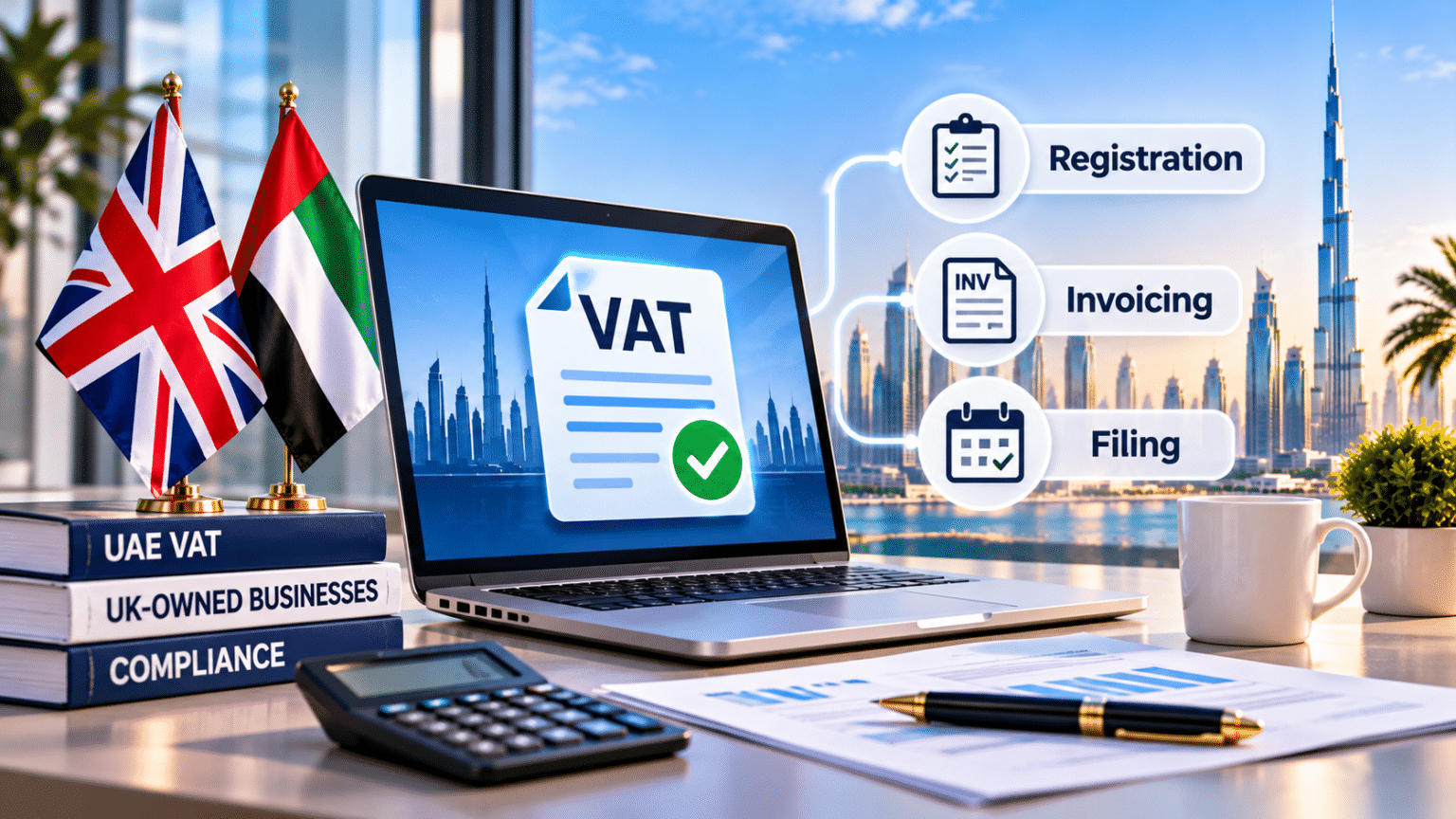
When a UK entrepreneur establishes a company in the UAE, Corporate Tax is not the only compliance issue to consider. Value Added Tax (VAT) can affect pricing, invoicing, cash flow and reporting obligations from the start of trading.
The UAE introduced VAT on 1 January 2018. The standard rate is 5%, but not every transaction receives the same treatment. The correct VAT position depends on factors such as the type and place of supply, the customer, supporting evidence and whether a zero-rating or exemption applies.
For UK founders, understanding UAE VAT for UK-owned businesses is important when planning operations, issuing invoices, dealing with customers in different countries and managing tax returns. This guide explains registration thresholds, non-resident rules, invoicing and recordkeeping requirements, common mistakes and the support available from AB Capital.
Table of Contents
What Is the UAE VAT Rate?
The standard UAE VAT rate is 5%. VAT is generally charged on taxable supplies of goods and services, but the law distinguishes between standard-rated, zero-rated and exempt supplies.
| VAT treatment | General explanation |
|---|---|
| Standard-rated | VAT is generally charged at 5% on the relevant taxable supply. |
| Zero-rated | The supply is taxable at 0% where the specific legal conditions are met. |
| Exempt | The supply is exempt under applicable rules. Input VAT recovery may be restricted. |
A business should not assume every sale is automatically subject to 5%, or that every export or international transaction is automatically zero-rated. Cross-border services, goods moving between countries, designated-zone transactions and exports can involve specific place-of-supply rules and evidence requirements.
UK founders operating a UAE company should review each revenue stream and transaction type before deciding how VAT should be charged. The contract, customer location, nature of the supply and supporting documents may all affect the result.
When Does a UAE Business Need to Register for VAT?
For a UAE-resident business, mandatory VAT registration generally applies when the value of taxable supplies and imports exceeds AED 375,000 during the previous 12 months, or is expected to exceed that threshold in the next 30 days.
Voluntary VAT registration may be available when the value of taxable supplies and imports, or taxable expenses, exceeds AED 187,500, subject to the applicable rules.
- AED 375,000: General mandatory registration threshold.
- AED 187,500: General voluntary registration threshold, subject to the rules.
These thresholds should not be applied automatically to non-resident businesses. Their registration position requires a separate assessment.
The AED 375,000 test is not simply an annual turnover test based on a calendar or financial year. Businesses should monitor the rolling 12-month position and consider whether taxable supplies are expected to exceed the threshold in the next 30 days. Waiting until the financial year ends may result in a missed registration obligation.
What counts towards the registration threshold?
The registration test considers taxable supplies and imports under the applicable VAT rules. It is important to classify revenue correctly rather than relying only on total sales shown in management accounts. Exempt supplies and other transactions may be treated differently for threshold purposes.
Where a business is approaching the threshold, it should review contracts, invoices, imports and expected transactions and obtain advice on the correct registration date and process.
Does UK Ownership Change UAE VAT Obligations?
No. The nationality of a company’s shareholders does not, by itself, determine whether the company must register for UAE VAT. The assessment focuses on the taxable person, its place of residence, the nature and place of its supplies and imports, and the applicable registration rules.
A UK-owned company incorporated and operating in the UAE should assess its UAE VAT position in the same way as another UAE-resident business with comparable activities. If it makes taxable supplies in the UAE and meets the registration criteria, it may be required to register regardless of shareholder nationality.
A UK company that makes taxable supplies in the UAE without having a UAE establishment may need a separate non-resident VAT analysis. Relevant facts include who makes the supply, where the supply is treated as taking place and whether another person is responsible for accounting for VAT.
Special VAT Considerations for Non-Resident Businesses
The AED 375,000 threshold should not be treated as a general safe harbour for a non-UAE-resident business. A non-resident business making taxable supplies in the UAE may be required to register regardless of the value of those supplies where no other person is responsible for accounting for VAT.
A UK business supplying UAE customers should not assume it can wait until its sales reach the ordinary resident-business threshold. The VAT treatment depends on the facts of the transaction and the recipient’s role, including whether a reverse-charge mechanism or another applicable rule changes who accounts for VAT.
Before making cross-border supplies, review contractual arrangements, customer status, place-of-supply rules and the invoicing approach. If the business operates through both UK and UAE entities, assess which entity makes each supply and which entity has the relevant VAT obligations.
VAT Invoices and Recordkeeping
VAT-registered businesses must issue tax invoices or simplified tax invoices, as appropriate, and maintain records that support the VAT treatment reported in their returns. An effective invoicing process should capture details required by the rules, which may include supplier and customer information, invoice date, description of goods or services, value, VAT rate and VAT amount.
Documents businesses should retain
Keep supporting documents connected to each transaction together and accessible. Depending on the transaction, relevant records may include:
- Tax invoices and simplified tax invoices.
- Contracts, engagement letters and purchase orders.
- Shipping, customs and delivery documentation.
- Proof of export where zero-rating is claimed.
- Payment records and bank statements.
- Credit notes and evidence of adjustments.
- Accounting records supporting output VAT and recoverable input VAT.
Good documentation is particularly important when a business applies zero-rating or deals with cross-border transactions. The VAT treatment should be supported by relevant evidence, not just by the description entered into an accounting system.
VAT Returns and Common Mistakes
VAT returns are generally submitted through the Federal Tax Authority’s EmaraTax platform. Businesses should check the tax period and filing deadline assigned to them, reconcile accounting records and review the figures before submitting a return.
Common VAT mistakes to avoid
- Applying the resident threshold to every foreign business: Non-resident businesses may be subject to different registration rules.
- Assuming all international services are zero-rated: Place-of-supply and zero-rating conditions must be reviewed for each transaction.
- Claiming input VAT without adequate support: Keep required tax invoices and supporting records and check that recovery conditions are met.
- Failing to reconcile records: Sales, purchases, output VAT and recoverable input VAT should be checked against accounting records before filing.
- Ignoring new activities or sales channels: Changes in operations can affect VAT treatment and registration.
- Leaving registration until year-end: Monitor the rolling 12-month threshold and expected supplies.
For current procedures and registration information, consult the FTA VAT registration guidance and the FTA VAT Registration Service.
How AB Capital Can Help with UAE VAT Compliance
Managing VAT alongside company operations can be challenging, particularly for UK entrepreneurs establishing a UAE presence or managing transactions across both countries. AB Capital provides accounting and tax-compliance support to businesses operating in the UAE.
Depending on the company’s circumstances and agreed scope of work, support can include:
- VAT registration coordination: Assistance with understanding the registration process and organising information required for an application.
- Invoicing process review: Reviewing invoice workflows and identifying areas that may need attention.
- Bookkeeping and accounting: Support with maintaining organised financial records and transaction information.
- VAT return preparation assistance: Helping organise and review relevant information for VAT return preparation.
- Corporate Tax support: Assistance with related UAE Corporate Tax responsibilities.
- Company formation and business setup: Support for entrepreneurs establishing a UAE company.
- Corporate banking assistance: Guidance on documentation and the corporate bank account application process.
VAT treatment must always be confirmed against actual transaction facts and current FTA guidance. AB Capital can discuss your business requirements and the type of support that may be appropriate.
Planning to Establish or Operate a UAE Business?
Make sure VAT registration, invoicing and reporting are considered as part of your business planning. Speak with AB Capital about company formation, accounting and tax-compliance support for your UAE business.
AB Capital Services
Office No. 404, Al Tawhidi Building, Bank Street, Bur Dubai, UAE
Phone: +971 58 569 9300
Email: info@abcapital.ae
Contact AB Capital on WhatsApp | Visit the AB Capital UAE website
Related guidance and official resources: For context on the two tax systems, read UK Tax vs UAE Tax. The treaty and related documents are published in GOV.UK’s UAE tax treaties collection. Individuals should also review the UK Statutory Residence Test guidance.
Chat with AB Capital on WhatsAppAlso Read
- UK Tax vs UAE Tax – Key tax considerations when comparing the two jurisdictions.
- Dubai Company Formation for UK Residents – Explore the company setup process for UK entrepreneurs.
- AB Capital UAE – Explore company formation, accounting and business support services.
Frequently Asked Questions About UAE VAT for UK-Owned Businesses
1. What is the VAT rate in the UAE?
The UAE standard VAT rate is 5%. However, not every supply is necessarily charged at 5%. Depending on the type and place of supply and the relevant legal conditions, a transaction may be standard-rated, zero-rated or exempt. Businesses should assess each type of supply and retain documents supporting the treatment used in their VAT returns.
2. What is the UAE VAT registration threshold for a company?
For a UAE-resident business, mandatory VAT registration generally applies when taxable supplies and imports exceed AED 375,000 over the previous 12 months, or are expected to exceed AED 375,000 in the next 30 days. Voluntary registration may be available when taxable supplies and imports, or taxable expenses, exceed AED 187,500, subject to applicable rules. A business should monitor the threshold on a rolling basis rather than checking only at the end of its financial year.
3. Does a UK-owned company in Dubai need to register for UAE VAT?
It may need to register if it meets UAE VAT registration criteria. Shareholder nationality does not, by itself, determine the company’s VAT position. The assessment focuses on the taxable person, its place of residence, the nature and value of taxable supplies and imports, and applicable registration rules. A UK-owned UAE company should review its transactions and monitor the relevant thresholds like other UAE-resident businesses.
4. Does the AED 375,000 VAT threshold apply to a UK company with no UAE establishment?
Not necessarily. The AED 375,000 threshold should not be treated as a general registration threshold for non-resident businesses. A non-UAE-resident business making taxable supplies in the UAE may be required to register regardless of the value of those supplies where no other person is responsible for accounting for VAT. The correct position depends on the supply, place-of-supply rules and recipient’s role. A UK business supplying UAE customers should obtain a transaction-specific assessment before relying on the resident-business threshold.
5. Are exports and services supplied to overseas customers always zero-rated?
No. A business should not assume every export or international service qualifies for zero-rating. The VAT treatment depends on the type of supply, place-of-supply rules and conditions and evidence required by UAE VAT rules. Goods exports may require appropriate shipping or customs evidence, while cross-border services require a separate analysis of the service and customer circumstances. Keep contracts, invoices and supporting documents that demonstrate why a particular VAT treatment was applied.
6. What documents should a UAE VAT-registered business keep?
Businesses should retain tax invoices or simplified tax invoices as appropriate, purchase and sales records, contracts, purchase orders, credit notes, bank and payment records, and relevant shipping, customs or export evidence. Records should support the VAT treatment declared in returns, including output VAT charged and input VAT claimed. The exact records required depend on the transactions and applicable rules.
7. Where can a business register for VAT in the UAE?
VAT registration is handled through the Federal Tax Authority’s EmaraTax services. Businesses can consult the FTA VAT registration guidance and the VAT Registration Service for current instructions. Before applying, the business should confirm whether it meets the relevant registration criteria and prepare required company and financial information.
8. How are UAE VAT returns filed?
VAT returns are generally submitted through the FTA’s EmaraTax platform. The business should check its assigned tax period and filing deadline, reconcile sales and purchases, review output VAT and recoverable input VAT, and make sure the return agrees with supporting accounting records. If the company has cross-border transactions, zero-rated supplies or adjustments, those items should be reviewed carefully before submission.
9. Can AB Capital help with VAT registration and returns?
AB Capital provides accounting and tax-compliance support for businesses operating in the UAE. Depending on the company’s circumstances and agreed scope, support may include VAT registration coordination, review of invoicing processes, bookkeeping, organising financial records and assistance with VAT return preparation. The appropriate VAT treatment should always be confirmed against transaction facts and current FTA guidance.
Disclaimer: This article is for general information only and is not legal, tax, accounting or banking advice. VAT rules and official guidance may change. Confirm the current position with the Federal Tax Authority and obtain professional advice based on your business and transaction facts.