


Quick Answer
Dubai has over 30 designated free zones operating in 2026, each with its own licensing authority, industry focus, visa quota system, office requirements, and fee structure. Free zones in Dubai offer 100% foreign ownership, customs duty advantages on imports and re-exports, streamlined visa processing, and for qualifying businesses, a 0% corporate tax rate on qualifying income under the UAE corporate tax framework. Setup costs across Dubai free zones range from AED 5,750 for a basic license at IFZA or Meydan to AED 70,000 or more at DIFC or DMCC for a full office setup. Choosing the right free zone requires matching your business activity, target market, visa needs, budget, and banking priorities to the specific strengths of each zone.
1. What Are Free Zones in Dubai?
Free zones in Dubai are designated economic areas established under specific laws that sit outside the standard mainland commercial framework governed by the Dubai Department of Economy and Tourism (DET). Each free zone has its own regulatory authority, its own licensing procedures, and in some cases its own legal system. DIFC, for example, operates under an English Common Law framework with its own courts, while DMCC and JAFZA operate under UAE law with their own specific regulations.
The concept emerged in the 1980s when Jebel Ali Free Zone was established to attract foreign manufacturers and traders with incentives unavailable on the mainland. The model proved so successful that Dubai systematically built specialised free zones around every major industry sector over the following four decades. By 2026, free zones cover commodities, financial services, technology, media, healthcare, education, logistics, manufacturing, aviation, maritime, design, and general business.
The core distinction from mainland: a free zone company operates within its designated zone and is primarily oriented toward international trade. It does not automatically have the right to trade directly with UAE mainland consumers or entities — that requires either a mainland distributor, a DET trading permit, or a separate mainland company. This is the most important practical limitation to understand before choosing a free zone over the mainland.
2. Key Benefits of Setting Up in a Dubai Free Zone
100% Foreign Ownership
All Dubai free zones permit 100% foreign ownership without any requirement for a UAE national partner, local sponsor, or local service agent. This has been the case since the first free zone was established and it predates the 2021 mainland ownership reforms. For foreign entrepreneurs who want certainty of complete ownership from Day 1, a free zone remains the cleanest structural choice.
0% Corporate Tax on Qualifying Income
Free zone companies that qualify as Qualifying Free Zone Persons under the UAE Corporate Tax Law (Federal Decree Law No. 47 of 2022) can access a 0% corporate tax rate on qualifying income. Qualifying activities include manufacturing, processing, distribution of goods or services to or from a designated zone, holding of shares and other securities, treasury and financing services, shipping operations, aircraft operations and leasing, and headquartering functions for multinational groups.
Non-qualifying income — revenue from mainland UAE clients, from certain financial services, and from activities not on the qualifying list — is taxed at 9% on profits above AED 375,000. The de minimis threshold allows non-qualifying revenue up to the lower of AED 5 million or 5% of total revenue without losing qualifying status for the entire period. Businesses that primarily serve international markets from a Dubai free zone can structure their operations to maintain 0% effective corporate tax legally.
Customs Duty Advantages
Goods imported into a UAE free zone or moved between free zones are exempt from UAE customs duty as long as they remain within the free zone or are re-exported internationally. The standard UAE customs duty rate of 5% applies only when goods are transferred from the free zone into the UAE mainland market. For businesses in import, trading, and re-export, this creates a significant cost advantage — goods can be received, stored, processed, and shipped internationally from Dubai without triggering customs duty liability.
Full Profit Repatriation
There are no restrictions on repatriating profits from a Dubai free zone company to any country. Shareholders can transfer 100% of dividends, capital, and proceeds to international accounts without withholding tax, capital controls, or regulatory approval. This applies equally to mainland companies in the UAE, but the free zone structure makes it administratively simpler because the banking and corporate setup is typically handled through the free zone’s preferred banking partners.
Streamlined Visa Processing
Free zone authorities act as the employer of record for UAE immigration purposes, processing visa applications, medical tests, and Emirates ID applications through their own immigration file rather than through MOHRE. This typically reduces processing time to 10 to 20 working days compared to the mainland process. The visa quota — the maximum number of employee visas a company can hold — is tied to the office space package chosen. Flexi desk packages allow 1 to 3 visas. Serviced office packages allow 3 to 6 visas. Dedicated office space increases the quota proportionally based on floor area.
Industry-Specific Ecosystems
Each free zone is designed around a specific industry, which means the regulatory framework, the tenants, the events, and the infrastructure are all aligned with that sector. A technology company setting up in Dubai Internet City has access to a community of hundreds of technology firms, accelerator programmes, investor networks, and government innovation initiatives that do not exist in a generic business park. This ecosystem value is one of the most underestimated benefits of free zone setup — the commercial connections and market access that come from operating within an established industry cluster.
No Minimum Share Capital for Most Free Zones
Most Dubai free zones do not require a minimum paid-up share capital to register a company. DMCC requires AED 50,000 in share capital, and DIFC has its own capital requirements for regulated entities. But IFZA, Meydan, Dubai Silicon Oasis, Dubai Media City, Dubai Internet City, and most other free zones have no minimum share capital requirement. This dramatically reduces the barrier to entry compared to some mainland jurisdictions and many international company formation destinations.
Some free zone companies can also hold real estate. See the property ownership rules for free zone companies.
3. Complete List of Free Zones in Dubai 2026
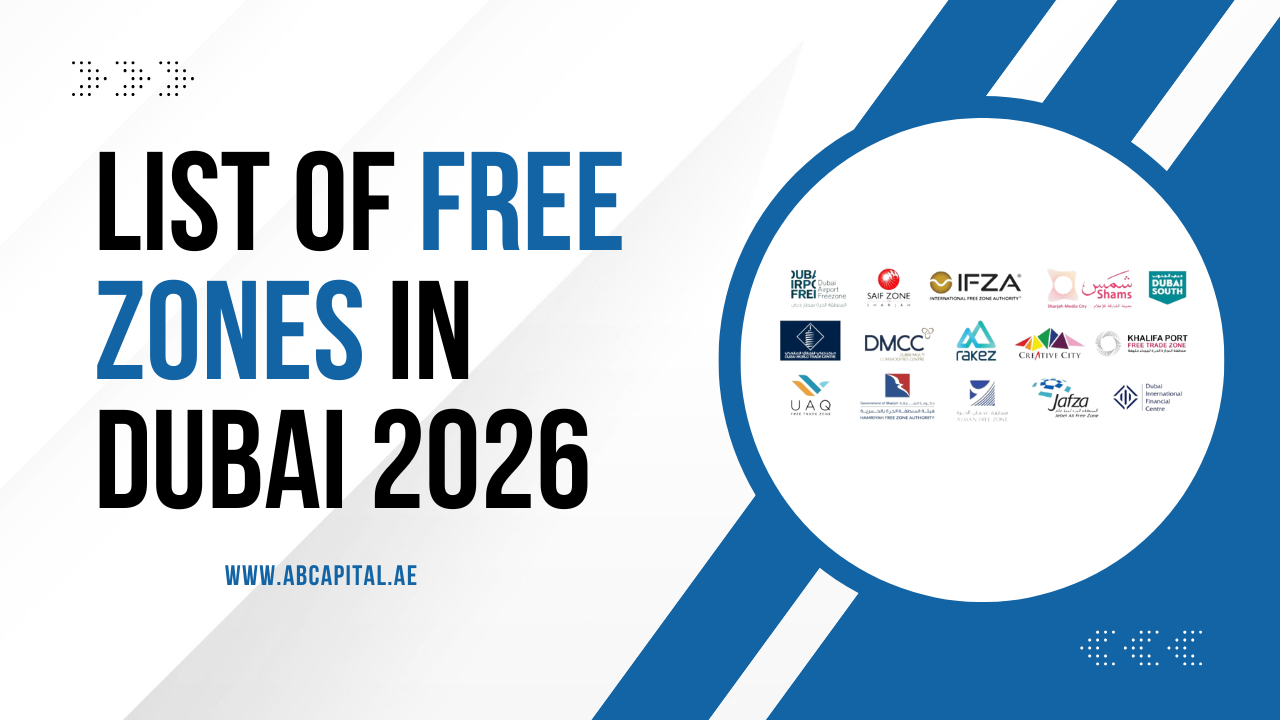
The following is the complete list of all designated free zones operating in Dubai in 2026, organised by their governing authority and primary industry focus.
Dubai Multi Commodities Centre (DMCC) Cluster
DMCC is the world’s largest free zone by registered companies, hosting over 24,000 companies from 180 countries as of 2026. It operates primarily from the Jumeirah Lakes Towers (JLT) district and has been named Global Free Zone of the Year by fDi Intelligence for nine consecutive years.
- Dubai Multi Commodities Centre (DMCC): Covers commodities trading, precious metals, diamonds, tea, coffee, energy, fintech, and a broad range of professional services. One of the most credible and internationally recognised free zone addresses globally.
- Dubai Gold and Diamond Park (DGDP): Specialist zone for jewellery manufacturers, traders, and retailers. Includes dedicated manufacturing facilities, retail showrooms, and trading offices in a single integrated campus.
Dubai Development Authority (DDA) Cluster
The Dubai Development Authority, formerly known as the Dubai Creative Clusters Authority, governs a group of free zones focused on knowledge, media, technology, and creative industries. All DDA zones share infrastructure and certain regulatory frameworks but operate as distinct licensing entities.
- Dubai Media City (DMC): The Middle East’s largest media cluster. Covers journalism, broadcasting, publishing, advertising, public relations, music production, and digital content. Home to regional headquarters of BBC, CNN, Reuters, and major advertising networks.
- Dubai Internet City (DIC): The technology and IT services hub. Hosts regional offices of Microsoft, Google, Facebook, Oracle, IBM, HP, and hundreds of technology SMEs. Focused on software development, IT consulting, e-commerce, and digital services.
- Dubai Knowledge Park (DKP): Focused on education, training, HR management, and coaching. Covers academic institutions, corporate training providers, and education technology companies. Freelancer permits available for individual educators and consultants.
- Dubai Studio City (DSC): Purpose-built for film, television, and content production. Includes film studios, post-production facilities, and media production companies. Part of the Dubai Production City complex.
- Dubai Production City (DPC): Covers printing, publishing, packaging, and media production. Located adjacent to Dubai Studio City with shared infrastructure.
- Dubai Science Park (DSP): Focused on life sciences, healthcare, biotechnology, pharmaceutical research, and environmental science. Provides laboratory facilities and research infrastructure for science-based businesses.
- Dubai Design District (d3): The creative industries hub covering fashion, design, architecture, luxury goods, and art. Houses major fashion brands, design firms, and luxury retail. Hosts Dubai Design Week and major industry events annually.
JAFZA and Dubai South
These two free zones are purpose-built around physical infrastructure — the Jebel Ali Port and Al Maktoum International Airport respectively — and are the primary choices for businesses with significant physical goods flows.
- Jebel Ali Free Zone Authority (JAFZA): The UAE’s oldest and largest logistics and industrial free zone. Directly adjacent to Jebel Ali Port, which handles over 14 million TEUs annually and connects to 150 ports across the globe. JAFZA is the preferred zone for manufacturing, heavy industry, automotive, oil and gas equipment, and large-scale warehousing and distribution.
- Dubai South (Dubai World Central): Built around Al Maktoum International Airport, the zone undergoing a USD 35 billion expansion to become the world’s largest airport by capacity. Dubai South is the primary zone for aviation, aerospace, e-commerce logistics, and businesses requiring direct airport adjacency. The logistics district and the business park district operate within Dubai South.
Dubai Airport Free Zone Authority (DAFZA)
DAFZA operates within the perimeter of Dubai International Airport — the world’s busiest international airport. Direct airside access is available to certain DAFZA tenants, making it the only Dubai free zone with physical connectivity to a major international airport’s cargo operations. DAFZA is the first choice for businesses in air freight, perishable goods, electronics distribution, express courier operations, and any business where speed of international shipment is a competitive factor.
Dubai International Financial Centre (DIFC)
DIFC is the most distinctive and prestigious free zone in Dubai, operating under an independent English Common Law legal system with its own courts — the DIFC Courts — that handle commercial disputes under Common Law principles. This makes DIFC the only jurisdiction in the Middle East offering contractual certainty and dispute resolution on par with London or Singapore for international financial transactions.
DIFC hosts over 7,700 registered companies including over 980 entities regulated by the Dubai Financial Services Authority (DFSA). In H1 2025 alone, DIFC registered 1,081 new companies, a 32% increase year on year. DIFC is the mandatory choice for hedge funds, private equity firms, banks seeking to serve institutional clients, wealth management companies, family offices, international law firms, and any professional services firm that needs Common Law credibility with international institutional clients.
Sector-Focused Free Zones
- Dubai Healthcare City (DHCC): The Arab world’s largest healthcare free zone. Covers hospitals, clinics, medical education, pharmaceutical companies, medical device suppliers, and health technology firms. All healthcare businesses operating within DHCC must be licensed by the Dubai Health Authority and the DHCC authority simultaneously.
- Dubai International Academic City (DIAC): Focuses on higher education institutions. Hosts over 25 universities and colleges. Designed for international universities establishing UAE campuses.
- Dubai Silicon Oasis (DSO): A technology and innovation zone offering full residential, commercial, and industrial facilities in a single integrated development. Particularly suited for hardware technology, semiconductor, engineering, and deep technology companies requiring laboratory and workshop facilities.
- Dubai Airport Free Zone (DAFZA): As detailed above. Aviation, high-value goods, and time-sensitive logistics.
- Dubai Flower Centre (DFC): Specialist zone for cut flowers and ornamental plants. Part of Dubai International Airport’s cargo infrastructure with temperature-controlled facilities.
- Dubai Auto Zone (DAZ) and Dubai Cars and Automotive Zone (DUCAMZ): Both zones serve the automotive sector. DAZ focuses on auto parts trading and distribution. DUCAMZ provides infrastructure for used car trading, automotive services, and vehicle export.
- Dubai Logistics City (DLC): Part of Dubai South. Dedicated to third-party logistics, freight forwarding, supply chain management, and integrated logistics services.
- Dubai Maritime City Authority (DMCA): Focuses on marine industries including shipbuilding, ship repair, marine services, and maritime technology. Located on the Dubai coastline with dedicated marine access.
- Dubai CommerCity: The UAE’s first dedicated e-commerce free zone. Provides warehousing, fulfilment, and last-mile delivery infrastructure specifically designed for online retail businesses.
- Dubai Industrial City (DIC): Focuses on manufacturing and industrial production. Covers food and beverage manufacturing, base metals, chemicals, building materials, and industrial machinery.
- Dubai Techno Park (DTP): Focuses on clean technology, renewable energy, and advanced manufacturing.
- Dubai Textile City (DTC): Dedicated to textile manufacturing, trading, and distribution.
- Dubai World Trade Centre (DWTC): Primarily event-focused but also licenses businesses in its surrounding precinct.
- International Humanitarian City (IHC): United Nations-affiliated zone for humanitarian organisations, NGOs, and international aid bodies. Not available to commercial businesses.
- DUQE Free Zone: Located on the Queen Elizabeth 2 ship permanently docked in Dubai. Boutique free zone offering licenses for innovation-focused businesses.
Cost-Effective Multi-Activity Free Zones
- International Free Zone Authority (IFZA): One of the most popular free zones for SMEs and startups in 2026. License costs start from AED 5,750 for a basic package. Covers over 1,500 business activities across professional services, trading, consulting, and technology. No minimum share capital. Remote setup available. Widely used by international entrepreneurs who need a Dubai address without an industry-specific ecosystem.
- Meydan Free Zone: Located within the Meydan precinct near Downtown Dubai. Covers over 2,500 business activities under a single license. Offers a fully digital setup process with same-day license issuance for straightforward applications. MOFA-approved 10-year license available. Popular for consulting, technology, trading, and e-commerce businesses needing flexibility.
4. Dubai Free Zones Comparison Table 2026
The following table provides a side by side comparison of the major Dubai free zones on the factors that matter most for business setup decisions.
| Free Zone | Best For | Setup Cost (AED) | Min Share Capital | Physical Office Required | Visa Allocation |
|---|---|---|---|---|---|
| DMCC | Commodities, trading, fintech, crypto | 34,000 to 70,000+ | AED 50,000 | Yes — flexi desk minimum | 1 to 10+ |
| DIFC | Financial services, legal, professional services | 110,000 to 300,000+ | Varies by license type | Yes — mandatory | 1 to 6+ |
| JAFZA | Manufacturing, logistics, industrial | 15,000 to 55,000 | None stated | Yes — office or warehouse | 2 to 8+ |
| DAFZA | Aviation, high-value goods, tech | 30,000 to 55,000 | None | Yes | 1 to 6 |
| Dubai South | E-commerce, aviation, logistics | 12,000 to 30,000 | None | Flexi desk accepted | 1 to 4 |
| IFZA | SMEs, startups, consulting, trading | 5,750 to 30,000 | None | No (flexi desk/virtual) | 1 to 6 |
| Meydan | Consulting, tech, e-commerce, general | 5,750 to 25,000 | None | No (flexi desk/virtual) | 1 to 5 |
| DSO | Technology, engineering, deep tech | 15,000 to 35,000 | None | Office or co-work | 1 to 6 |
| DMC | Media, PR, broadcasting, content | 18,000 to 40,000 | None | Flexi desk minimum | 1 to 6 |
| DIC | Technology, IT, software, digital | 18,000 to 40,000 | None | Flexi desk minimum | 1 to 6 |
| DHCC | Healthcare, pharma, medical devices | 20,000 to 50,000 | None | Yes | 1 to 6 |
| DKP | Education, training, HR, coaching | 16,000 to 35,000 | None | Flexi desk minimum | 1 to 6 |
| d3 | Fashion, design, architecture, luxury | 20,000 to 45,000 | None | Yes for most activities | 1 to 6 |
| Dubai CommerCity | E-commerce, fulfilment, online retail | 18,000 to 40,000 | None | Flexi desk or warehouse | 1 to 6 |
5. How to Choose the Right Free Zone in Dubai: A Decision Framework
Choosing a free zone is one of the most consequential decisions in the business setup process. It determines your regulatory environment, your banking relationships, your visa quota, your credibility with clients, and your ongoing costs. The decision should not be made on license price alone.
Step 1: Define your business activity precisely
Every free zone has an approved list of business activities. Some activities are only available in specific zones. A pharmaceutical distribution company can only operate legally from DHCC or JAFZA with the appropriate DHA approvals — it cannot set up in IFZA and conduct the same activity. Before comparing free zones, confirm which zones include your specific activity in their approved list. Choosing the wrong zone and then attempting to change activity or jurisdiction later costs more than choosing correctly at the outset.
Step 2: Determine your target market
This is the most important strategic question. If your primary customers are UAE mainland businesses, government entities, or UAE consumers, a free zone may not be the right structure. Free zone companies cannot sell directly to UAE mainland customers without a mainland trading permit or through a registered mainland distributor. If you need unrestricted UAE mainland market access, a mainland DET license is the correct choice.
If your business primarily serves international clients, exports goods internationally, or operates in a B2B environment with other free zone companies, a free zone is well suited. If your business is a mix of both, consider either a mainland license or a dual license arrangement — maintaining both a free zone entity for international operations and a mainland entity for local sales.
Step 3: Calculate your true total cost of ownership
The license fee is the most visible cost but not the largest one in most cases. The total cost of operating from a Dubai free zone includes:
- Annual license fee
- Office space cost — flexi desk, serviced office, or dedicated unit
- Visa costs per person — AED 3,500 to AED 7,500 per visa
- Health insurance — mandatory, AED 600 to AED 3,000 per person per year
- Liquidation audit report — AED 1,500 to AED 5,000 per year for most free zones upon renewal or cancellation
- Banking fees and minimum balance requirements
- Corporate tax registration (FTA) — free but required within 3 months of incorporation
A license that appears cheap at AED 5,750 but requires an audit costing AED 3,000, a visa at AED 5,000, and a minimum bank balance of AED 25,000 has a real first-year cost closer to AED 35,000 to AED 40,000. Compare total operating cost, not license fee alone.
Step 4: Assess banking compatibility
Not all free zones have equal banking relationships. DMCC and DIFC companies open corporate bank accounts with significantly less friction than some smaller or newer free zones. Banks in the UAE assess the credibility and compliance quality of the free zone as part of their KYC review of the company. A DIFC company is unlikely to be rejected by any UAE bank based on its jurisdiction alone. An IFZA or Meydan company is widely accepted but may require more documentation.
If your business involves regulated activities, cross-border payments, or high-value transactions, choose a free zone with a strong banking ecosystem. DMCC, DIFC, and JAFZA all have established preferred banking relationships that simplify the account opening process significantly.
Step 5: Consider visa quota needs
The number of employees you plan to hire in the UAE determines the office space you need, which determines your free zone cost structure. A solo founder needing only their own investor visa can operate from a virtual office or flexi desk at most free zones. A business planning to hire 10 to 20 staff in the first year needs a dedicated office, which significantly increases cost and potentially changes the most suitable free zone. Map your 3-year hiring plan before committing to an office package — upgrading later is possible but always involves administrative cost and downtime.
6. Free Zone vs Mainland: When Each Is the Right Choice
| Scenario | Recommended Structure | Reason |
|---|---|---|
| Primarily serving international clients | Free zone | No mainland market access needed; tax efficiency maximised |
| Selling to UAE consumers or retailers directly | Mainland | Free zone cannot trade directly with UAE market |
| Bidding for UAE government contracts | Mainland | Most government tenders require mainland DET license |
| Financial services for international clients | DIFC | Common law framework and DFSA regulation required |
| Logistics and physical goods with port access | JAFZA or Dubai South | Port and airport infrastructure critical to operations |
| Technology startup targeting global market | IFZA, DIC, or DSO | Cost-effective setup with tech ecosystem |
| Media or content business | DMC | Industry ecosystem and client base concentrated here |
| Healthcare business | DHCC | Mandatory for DHA-regulated health activities |
| Maximum flexibility with lowest cost | IFZA or Meydan | Broadest activity coverage at lowest price point |
| Maximum credibility for institutional clients | DIFC or DMCC | Globally recognised jurisdictions with strong compliance frameworks |
7. How to Set Up a Company in a Dubai Free Zone: Step by Step
While each free zone has its own specific process, the general sequence for company formation in a Dubai free zone follows a consistent structure.
- Step 1 — Choose your free zone and confirm your activity is approved. Check the free zone’s official activity list. If your specific activity is not listed, contact the free zone authority to confirm whether a similar activity code covers your business.
- Step 2 — Select your license type. Free zone licenses are typically issued as professional licenses for service businesses, commercial licenses for trading activities, or industrial licenses for manufacturing. Some free zones issue a single general license covering multiple activity types.
- Step 3 — Reserve your trade name. Submit 3 to 5 trade name options to the free zone authority. Names must not duplicate existing registrations, must not include restricted words, and must be in English or Arabic. Approval takes 1 to 3 working days.
- Step 4 — Select your office package. Choose between virtual office, flexi desk, serviced office, or dedicated unit based on your visa quota needs and budget.
- Step 5 — Submit your application and documents. Submit passport copies of all shareholders, photographs, business plan if required, and the completed free zone application form through the free zone’s online portal.
- Step 6 — Pay the license fee and receive your trade license. Once the application is reviewed and approved, pay the applicable fees and receive your trade license — typically within 3 to 15 working days.
- Step 7 — Apply for the establishment card. This document links your company to the immigration system and is required before any visa applications can be processed.
- Step 8 — Process investor and employee visas. Submit visa applications through the free zone authority’s immigration portal. The full visa process including entry permit, medical test, Emirates ID, and residence stamp takes 10 to 20 working days.
- Step 9 — Open a corporate bank account. With your trade license and establishment card, approach your chosen UAE bank. Prepare a full documentation package including business plan, shareholder documents, proof of address, source of funds, and source of wealth statements.
- Step 10 — Register for corporate tax with the FTA. All UAE companies must register for corporate tax with the Federal Tax Authority within 3 months of incorporation. Registration is through EmaraTax at emaratax.gov.ae.
Key Facts: Free Zones in Dubai 2026
| Item | Detail |
|---|---|
| Number of free zones in Dubai | Over 30 designated free zones in 2026 |
| Foreign ownership | 100% permitted in all Dubai free zones |
| Corporate tax on qualifying income | 0% for Qualifying Free Zone Persons meeting all conditions |
| Customs duty on imports to free zone | 0% as long as goods remain in zone or are re-exported |
| Cheapest free zone license in Dubai | AED 5,750 at IFZA and Meydan for basic packages |
| Most prestigious free zone | DIFC for financial services; DMCC for trading and commodities |
| DMCC company count | Over 24,000 companies from 180 countries as of 2026 |
| DIFC new registrations (H1 2025) | 1,081 new companies — 32% increase year on year |
| Free zone visa quota basis | Tied to office space — approximately 1 visa per 9 square metres |
| Minimum share capital | None for most free zones; AED 50,000 for DMCC |
| Physical office requirement | Mandatory for DIFC, JAFZA, DAFZA; flexi desk accepted at IFZA, Meydan, DIC, DMC |
| Free zone cannot do | Trade directly with UAE mainland without additional DET permit |
| Annual audit requirement | Mandatory for DMCC, DIFC, and most free zones for renewal |
| UAE mainland access option | DET mainland permit available for free zone companies |
Key Takeaways
- Dubai has over 30 free zones in 2026, each designed for specific industries — from DIFC for financial services to JAFZA for manufacturing and logistics to IFZA for cost-effective general business.
- 100% foreign ownership is available in all Dubai free zones with no requirement for a UAE national partner or local service agent.
- Free zone companies that qualify as Qualifying Free Zone Persons pay 0% corporate tax on qualifying income — compared to the standard 9% rate on profits above AED 375,000.
- IFZA and Meydan offer the lowest cost entry point from AED 5,750. DIFC is the most expensive but the most credible for financial and professional services with institutional clients.
- Free zone companies cannot sell directly to UAE mainland customers without a DET mainland trading permit or through a registered mainland distributor.
- The right free zone choice depends on business activity, target market, visa quota needs, banking relationships, and total cost — not on license price alone.
- DMCC is the world’s most awarded free zone with over 24,000 member companies. DIFC is the only Middle East jurisdiction with English Common Law courts.
- Setup takes 3 to 15 working days for most free zones with complete documentation. The full process including visa and bank account takes 3 to 5 weeks.
Summary
Dubai’s free zone ecosystem in 2026 is the most developed and diverse in the world, offering businesses of every size and sector a legally credible, tax efficient, and operationally practical home for international operations. With over 30 free zones covering every major industry, setup costs ranging from AED 5,750 to AED 300,000 depending on the zone and structure, and a 0% corporate tax rate available for qualifying businesses, the choice of free zone is both the most important and the most nuanced decision in the business setup process. The right answer is determined by matching activity to zone, target market to structure, visa needs to office requirements, and long-term banking relationships to the zone’s credibility profile. IFZA and Meydan serve entrepreneurs who need a Dubai address, flexibility, and low cost. DMCC and DIFC serve businesses that need a globally recognised jurisdiction, a world-class peer network, and institutional-grade compliance infrastructure. JAFZA and Dubai South serve businesses built around physical goods and logistics. Between these anchors lies a rich variety of sector-specific zones that give Dubai’s free zone landscape its unique depth and commercial relevance.
FAQs: Free Zones in Dubai
1. How many free zones are there in Dubai in 2026?
There are over 30 designated free zones in Dubai in 2026. These include generalist free zones such as IFZA, Meydan, and DMCC, sector-specific zones such as DIFC for financial services, DHCC for healthcare, DMC for media, DIC for technology, JAFZA for logistics, and specialist zones for automotive, textiles, flowers, and maritime industries. The number continues to grow as Dubai expands its free zone offering in line with the D33 Economic Agenda’s sectoral priorities.
2. What is the cheapest free zone in Dubai?
The cheapest free zone setup in Dubai in 2026 starts from AED 5,750 at IFZA and Meydan Free Zone for a basic professional or commercial license without a dedicated office. This base price covers the license fee only. Adding a visa (AED 3,500 to AED 5,000), health insurance (AED 600 to AED 2,000 per year), and Emirates ID (AED 370) brings the true first-year cost to AED 10,000 to AED 15,000 for a solo operator. For businesses requiring warehouse space, manufacturing facilities, or a prestigious address in DMCC or DIFC, costs are substantially higher.
3. Can a free zone company sell to customers in the UAE mainland?
A free zone company cannot directly sell goods or services to UAE mainland customers without an additional permit. There are two practical routes. First, the free zone company can obtain a mainland trading permit from the Dubai Department of Economy and Tourism, which allows limited direct mainland trading activity. Second, the company can work through a registered mainland distributor or agent who holds their own DED license. For businesses with substantial UAE domestic market ambitions, maintaining a separate mainland entity alongside the free zone company is often the most operationally clean solution.
4. Do free zone companies pay corporate tax in the UAE?
Free zone companies are subject to UAE corporate tax under Federal Decree Law No. 47 of 2022. However, companies that qualify as Qualifying Free Zone Persons can access a 0% corporate tax rate on qualifying income. Qualifying income includes revenue from specific activities such as manufacturing, trading with other free zone companies, distribution internationally, holding of shares and securities, shipping, and certain financial services. Non-qualifying income — including revenue from mainland UAE clients — is taxed at 9% on profits above AED 375,000. Every free zone company must register for corporate tax with the FTA within 3 months of incorporation regardless of whether it expects to owe any tax.
5. Which Dubai free zone is best for technology companies?
For technology companies, the three primary options are Dubai Internet City (DIC), Dubai Silicon Oasis (DSO), and IFZA. DIC is the premium choice — it hosts regional offices of Microsoft, Google, Oracle, Cisco, and hundreds of technology firms, and the ecosystem provides direct access to investor networks, talent pools, and enterprise clients. DSO is better suited for hardware technology, engineering, and deep technology businesses that need laboratory or workshop facilities within the free zone. IFZA is the most affordable option for software, consulting, and digital services businesses that do not require an industry-specific ecosystem but want a Dubai address at a low cost.
6. What is special about DIFC compared to other Dubai free zones?
DIFC (Dubai International Financial Centre) operates under an independent English Common Law legal system with its own courts — the DIFC Courts — separate from UAE civil law. This makes it the only jurisdiction in the Middle East offering Common Law contractual and dispute resolution framework on par with English or Singapore law. DIFC is regulated by the Dubai Financial Services Authority (DFSA), one of the most respected financial regulators in the world. For banks, hedge funds, private equity firms, family offices, and international law firms serving institutional clients, DIFC is not just the best option — it is often the only credible option. Setup costs at DIFC are significantly higher than other free zones, starting from AED 110,000 and reaching AED 300,000 or more for regulated financial services licenses.
Pingback: Sarah
Pingback: Sam
Pingback: Freezone vs Mainland UAE - The Real Cost Breakdown !
Pingback: Kiara
Pingback: Free Zone Dubai