

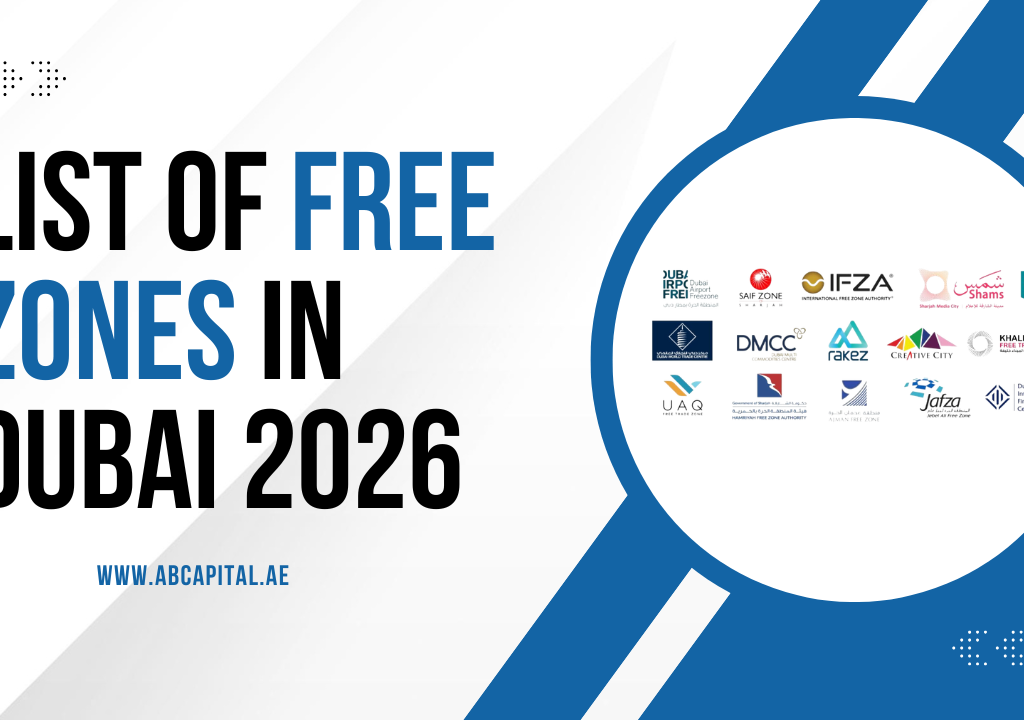
List of Free Zones in Dubai 2026: Complete Guide with Benefits, Costs and How to Choose the Right One
Quick Answer Dubai has over 30 designated free zones operating in 2026, each with its own licensing authority, industry focus, visa quota system, office requirements, and fee structure. Free zones in Dubai offer 100% foreign ownership, customs duty advantages on imports and re-exports, streamlined visa processing, and for qualifying businesses, a 0% corporate tax rate on qualifying income under the UAE corporate tax framework. Setup costs across Dubai free zones range from AED 5,750 for a basic license at IFZA or Meydan to AED 70,000 or more at DIFC or DMCC for a full office setup. Choosing the right free zone requires matching your business activity, target market, visa needs, budget, and banking priorities to the specific strengths of each zone. 1. What Are Free Zones in Dubai? Free zones in Dubai are designated economic areas established under specific laws that sit outside the standard mainland commercial framework governed by the Dubai Department of Economy and Tourism (DET). Each free zone has its own regulatory authority, its own licensing procedures, and in some cases its own legal system. DIFC, for example, operates under an English Common Law framework with its own courts, while DMCC and JAFZA operate under UAE law with their own specific regulations. The concept emerged in the 1980s when Jebel Ali Free Zone was established to attract foreign manufacturers and traders with incentives unavailable on the mainland. The model proved so successful that Dubai systematically built specialised free zones around every major industry sector over the following four decades. By 2026, free zones cover commodities, financial services, technology, media, healthcare, education, logistics, manufacturing, aviation, maritime, design, and general business. The core distinction from mainland: a free zone company operates within its designated zone and is primarily oriented toward international trade. It does not automatically have the right to trade directly with UAE mainland consumers or entities — that requires either a mainland distributor, a DET trading permit, or a separate mainland company. This is the most important practical limitation to understand before choosing a free zone over the mainland. 2. Key Benefits of Setting Up in a Dubai Free Zone 100% Foreign Ownership All Dubai free zones permit 100% foreign ownership without any requirement for a UAE national partner, local sponsor, or local service agent. This has been the case since the first free zone was established and it predates the 2021 mainland ownership reforms. For foreign entrepreneurs who want certainty of complete ownership from Day 1, a free zone remains the cleanest structural choice. 0% Corporate Tax on Qualifying Income Free zone companies that qualify as Qualifying Free Zone Persons under the UAE Corporate Tax Law (Federal Decree Law No. 47 of 2022) can access a 0% corporate tax rate on qualifying income. Qualifying activities include manufacturing, processing, distribution of goods or services to or from a designated zone, holding of shares and other securities, treasury and financing services, shipping operations, aircraft operations and leasing, and headquartering functions for multinational groups. Non-qualifying income — revenue from mainland UAE clients, from certain financial services, and from activities not on the qualifying list — is taxed at 9% on profits above AED 375,000. The de minimis threshold allows non-qualifying revenue up to the lower of AED 5 million or 5% of total revenue without losing qualifying status for the entire period. Businesses that primarily serve international markets from a Dubai free zone can structure their operations to maintain 0% effective corporate tax legally. Customs Duty Advantages Goods imported into a UAE free zone or moved between free zones are exempt from UAE customs duty as long as they remain within the free zone or are re-exported internationally. The standard UAE customs duty rate of 5% applies only when goods are transferred from the free zone into the UAE mainland market. For businesses in import, trading, and re-export, this creates a significant cost advantage — goods can be received, stored, processed, and shipped internationally from Dubai without triggering customs duty liability. Full Profit Repatriation There are no restrictions on repatriating profits from a Dubai free zone company to any country. Shareholders can transfer 100% of dividends, capital, and proceeds to international accounts without withholding tax, capital controls, or regulatory approval. This applies equally to mainland companies in the UAE, but the free zone structure makes it administratively simpler because the banking and corporate setup is typically handled through the free zone’s preferred banking partners. Streamlined Visa Processing Free zone authorities act as the employer of record for UAE immigration purposes, processing visa applications, medical tests, and Emirates ID applications through their own immigration file rather than through MOHRE. This typically reduces processing time to 10 to 20 working days compared to the mainland process. The visa quota — the maximum number of employee visas a company can hold — is tied to the office space package chosen. Flexi desk packages allow 1 to 3 visas. Serviced office packages allow 3 to 6 visas. Dedicated office space increases the quota proportionally based on floor area. Industry-Specific Ecosystems Each free zone is designed around a specific industry, which means the regulatory framework, the tenants, the events, and the infrastructure are all aligned with that sector. A technology company setting up in Dubai Internet City has access to a community of hundreds of technology firms, accelerator programmes, investor networks, and government innovation initiatives that do not exist in a generic business park. This ecosystem value is one of the most underestimated benefits of free zone setup — the commercial connections and market access that come from operating within an established industry cluster. No Minimum Share Capital for Most Free Zones Most Dubai free zones do not require a minimum paid-up share capital to register a company. DMCC requires AED 50,000 in share capital, and DIFC has its own capital requirements for regulated entities. But IFZA, Meydan, Dubai Silicon Oasis, Dubai Media City, Dubai Internet City, and most other free zones have no minimum share capital requirement. This dramatically reduces the barrier