

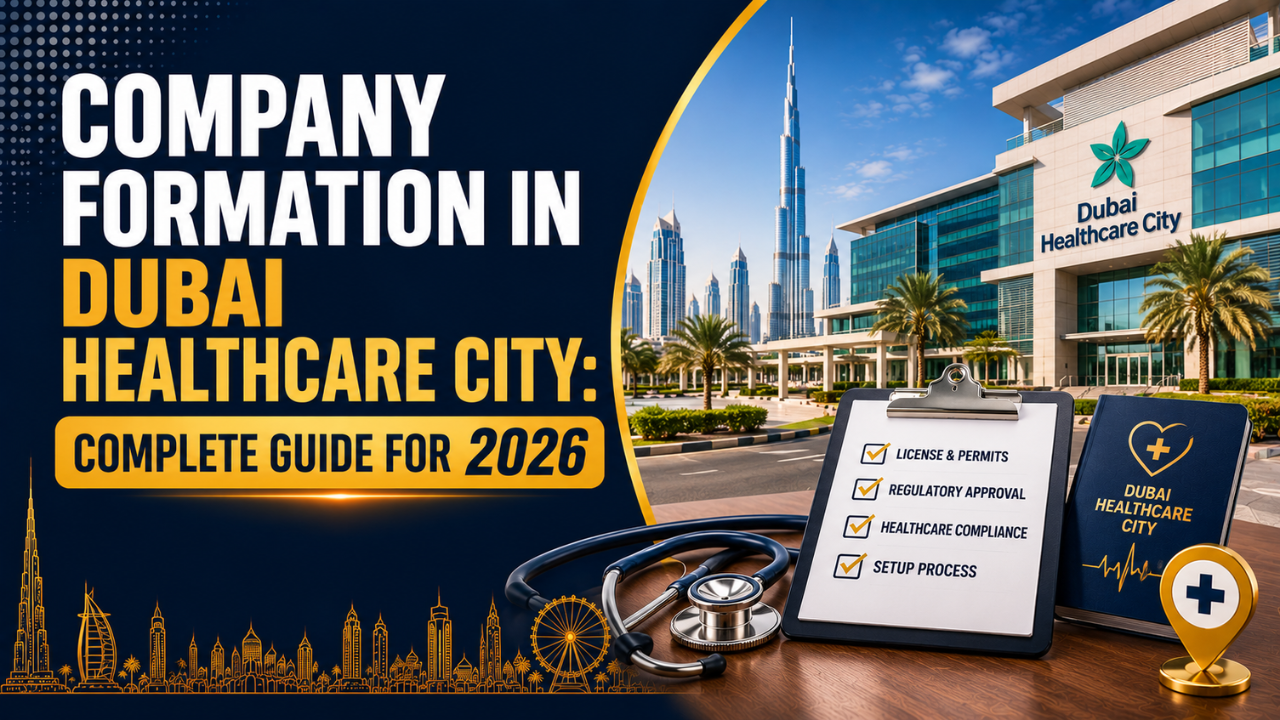
Quick answer: Company formation in Dubai Healthcare City (DHCC) allows entrepreneurs, healthcare professionals, investors and businesses to establish a company within Dubai’s specialised healthcare and wellness Free Zone. DHCC supports both clinical and non-clinical businesses, with legal structures including a Free Zone Limited Liability Company (FZ-LLC) and branches of UAE or foreign companies. The setup process depends heavily on whether the business is clinical or non-clinical, because healthcare operators and professionals require additional regulatory approvals and licences.
DHCC is not only for hospitals and doctors. The ecosystem also covers areas such as healthcare, wellness, education, hospitality, retail and other supporting businesses. This makes it an interesting option for entrepreneurs who want to build a business around Dubai’s growing healthcare and wellness sector.
If you are considering company formation in Dubai Healthcare City in 2026, the most important thing is to understand which type of business you are establishing and what approvals it will need before you start the application.
What is Dubai Healthcare City?
Dubai Healthcare City, commonly known as DHCC, is a specialised healthcare and wellness Free Zone in Dubai.
It was created as an ecosystem where healthcare providers, medical professionals, businesses, researchers and supporting companies can operate within a dedicated environment.
DHCC currently operates across two main locations:
- Phase 1: Oud Metha
- Phase 2: Al Jaddaf
The ecosystem includes healthcare facilities as well as businesses supporting healthcare, wellness, retail, hospitality, education and related sectors.
For businesses, the main attraction is that you are not simply setting up a company in Dubai. You are entering an environment built around a specific industry.
Is Dubai Healthcare City a Free Zone?
Yes.
Dubai Healthcare City is a Free Zone and offers 100% ownership for businesses established within its framework. DHCC also supports different investment models, including leasing, freehold land and joint ventures, depending on the project.
This can make DHCC attractive to international entrepreneurs and investors who want to establish a Dubai business without bringing in a local equity partner.
However, healthcare businesses have an additional layer of regulation. Owning the company and being permitted to provide healthcare services are two separate considerations.
Clinical vs Non-Clinical Company Formation in DHCC
This is probably the most important distinction to understand before setting up a company in Dubai Healthcare City.
Clinical Business
A clinical business provides healthcare services directly to patients.
Examples can include:
- Medical clinics
- Dental clinics
- Hospitals
- Diagnostic centres
- Medical centres
- Other healthcare facilities
These businesses require regulatory approval and facility licensing in addition to the commercial company setup.
Non-Clinical Business
A non-clinical business does not directly provide regulated healthcare treatment.
Examples can include businesses operating in:
- Healthcare consulting
- Wellness
- Education
- Retail
- Hospitality
- Healthcare-related services
- Supporting commercial activities
The licensing requirements can be simpler than those for clinical businesses, depending on the exact activity.
This distinction is important because a company cannot simply obtain a commercial licence and start providing medical services. Clinical facilities and healthcare professionals must obtain the relevant approvals and licences from DHCA – Regulations.
Why Choose Company Formation in Dubai Healthcare City?
DHCC can be a strong choice if your business is connected to healthcare, wellness or related industries.
Key advantages include:
- 100% ownership
- Healthcare-focused business ecosystem
- Dubai location
- Clinical and non-clinical business opportunities
- Access to specialised healthcare infrastructure
- Business opportunities across healthcare and wellness
- Support for startups and SMEs
- Different investment and workspace options
- Dedicated healthcare regulatory framework
- Potential access to specialised talent and professional networks
DHCC describes its ecosystem as a healthcare and wellness Free Zone with a community that includes healthcare providers and supporting businesses.
What Businesses Can Be Set Up in Dubai Healthcare City?
DHCC’s permitted activities cover more than traditional medical businesses.
The exact activity must be checked against the current permitted activity and licensing categories, but the wider DHCC ecosystem includes areas such as:
| Business Category | Examples |
| Healthcare | Clinics, medical centres and healthcare providers |
| Wellness | Wellness and personal care businesses |
| Education | Healthcare and related education |
| Research | Medical and scientific research |
| Retail | Healthcare-related retail |
| Hospitality | Healthcare and wellness hospitality |
| Professional Services | Approved supporting services |
| Technology | Approved healthcare and technology activities |
The authority actively encourages businesses across healthcare, education, hospitality, retail and wellness clusters.
Legal Structures Available in DHCC
The current DHCC regulations provide for several legal structures.
1. Free Zone Limited Liability Company
A Free Zone Limited Liability Company (FZ-LLC) is a company established within the Free Zone.
It can be suitable for investors who want to create a new business in DHCC.
The company has its own legal identity, while shareholder liability is generally limited according to the applicable legal framework.
2. Branch of a Foreign Company
An overseas company can establish a branch in DHCC, subject to the relevant requirements.
This can be useful for an international healthcare group or company that wants to establish a presence in Dubai without creating a completely separate business structure.
3. Branch of a UAE Company
A company already established elsewhere in the UAE may also be able to establish a branch in DHCC.
The exact requirements depend on the parent company’s structure and proposed activity.
DHCC’s current regulations recognise FZ-LLCs, branches of foreign companies and branches of UAE companies/establishments as legal structures.
DHCC Company Structure at a Glance
| Structure | Best Suited For |
| FZ-LLC | New businesses and investors |
| Foreign Company Branch | International companies expanding into Dubai |
| UAE Company Branch | Existing UAE businesses expanding into DHCC |
Choosing the structure should be based on your business plans, ownership, existing company structure and intended activities.
DHCC Commercial Licence
A company operating in Dubai Healthcare City needs the appropriate commercial licence for its approved activities.
DHCC’s regulations state that commercial licences are valid for one year and are renewable annually. The licence allows a company to conduct the activities approved for that business.
This means licence renewal should become part of your regular compliance calendar after incorporation.
Company Formation in Dubai Healthcare City: Step-by-Step Process
The exact process differs depending on whether you are establishing a clinical or non-clinical business.
Here’s the general process.
Step 1: Choose Your Business Activity
Start by clearly defining what the business will do.
This is especially important in DHCC because healthcare activities can have specific regulatory requirements.
For example, setting up:
A healthcare consultancy
is very different from setting up:
A medical clinic.
The second business will need additional facility and professional licensing.
Step 2: Choose the Legal Structure
Decide whether you need:
- FZ-LLC
- Foreign company branch
- UAE company branch
If you are starting a new company, an FZ-LLC may be appropriate.
If you already operate a company, a branch could be worth considering.
Step 3: Prepare Your Business Plan and Documents
DHCC requires applicants to submit an initial application and supporting information.
For healthcare operators, the authority may require documents such as:
- Business plan
- Passport copies
- CVs of shareholders
- CVs of directors
- CVs of managers
- Corporate documents, where applicable
- Existing commercial licence or certificate of incorporation for a branch
The exact documents depend on the proposed business and structure.
Step 4: Submit the Application
DHCC provides online services through its MASAAR system.
The application is reviewed by the relevant authority, with additional requirements depending on whether the business is clinical or non-clinical. DHCC describes its registration process as an online process through the MASAAR e-services system.
Step 5: Complete the Commercial Registration
Once the company application is approved and the relevant requirements are completed, the company can proceed with registration and commercial licensing.
For a non-clinical business, this may be the main licensing stage.
For a clinical business, there are additional steps before the facility can actually start treating patients.
Step 6: Arrange Your Facility or Office
Your premises depend on the type of business.
A normal office-based company and a medical clinic obviously have very different requirements.
For healthcare facilities, DHCA – Regulations reviews the proposed facility design and construction to ensure that it meets the applicable healthcare standards.
Step 7: Complete Additional Regulatory Approvals
This stage is particularly important for clinical businesses.
A healthcare operator may need to complete:
- Facility review
- Facility design approval
- Equipment requirements
- Pre-operational assessment
- Quality and patient safety requirements
- Clinical planning requirements
- Administrative requirements
A clinical operating licence is issued only after the applicable requirements have been satisfied.
Step 8: Obtain the Required Licence
Once all applicable requirements are completed, the business can obtain its relevant commercial and, where applicable, clinical operating approvals.
Only after obtaining the required licences should a healthcare business begin providing regulated services.
How Much Does Company Formation in Dubai Healthcare City Cost?
There is no single fixed price for company formation in Dubai Healthcare City.
The total cost depends heavily on the type of business.
A non-clinical consultancy may have a very different cost structure from a medical clinic or diagnostic facility.
Common cost areas include:
| Cost | What It May Cover |
| Company registration | Incorporation and registration |
| Commercial licence | Permission to conduct approved activities |
| Office/facility | Business premises |
| Facility approval | Applicable to clinical businesses |
| Professional licences | Healthcare professionals |
| Equipment | Clinical businesses |
| Visa | Investors and employees |
| Immigration | Establishment and related services |
| Documentation | Notarisation/attestation where required |
| Accounting | Ongoing financial management |
| Tax compliance | Corporate Tax/VAT where applicable |
For clinical businesses, facility construction, medical equipment and regulatory requirements can represent a significant part of the overall investment.
Minimum Capital Requirement in DHCC
The minimum paid-up capital depends on the type of business structure.
According to DHCC’s current FAQ:
- Clinical FZ-LLC: AED 300,000 minimum paid-up capital
- Non-clinical FZ-LLC: AED 50,000 minimum paid-up capital
- Branches: No minimum capital requirement stated by DHCC
These figures relate specifically to the applicable company structures and should not be confused with the total amount required to launch and operate the business. A clinical facility, for example, can require considerably more investment for premises, equipment, staff and approvals.
Can Foreigners Own a Company in Dubai Healthcare City?
Yes.
As a Free Zone, DHCC allows 100% ownership of businesses established within its framework.
This can make DHCC particularly attractive to international investors who want to establish a healthcare or wellness business in Dubai.
However, ownership of a company does not automatically give the owners or employees permission to practise medicine.
Healthcare professionals still need the appropriate professional licences.
Healthcare Professional Licensing in DHCC
This is an important point for anyone setting up a clinic or healthcare facility.
Doctors, dentists, nurses and other healthcare professionals must obtain the relevant professional licence from Dubai Healthcare City Authority – Regulatory (DHCA – Regulations).
The authority reviews professional qualifications and other requirements before issuing a licence. It also conducts Primary Source Verification for healthcare professional credentials.
Depending on the profession, applicants may need documents such as:
- Education certificates
- Professional qualifications
- Experience letters
- Current or previous professional registration
- Good Standing Certificate
- Passport
- Other professional documents
Some categories may also require an examination.
How Long Does DHCC Company Formation Take?
There is no single timeline that applies to every DHCC business.
A simple non-clinical company can generally have a much shorter setup process than a medical facility.
Clinical businesses can take longer because they may need:
- Facility approval
- Design review
- Construction
- Equipment approval
- Professional licensing
- Pre-operational assessment
DHCC describes its business registration process as streamlined and online, but the actual timeline depends on the business activity and the approvals required.
DHCC Commercial Licence vs Professional Licence
These two licenses should not be confused.
Commercial Licence
This relates to the company/business and allows it to conduct approved commercial activities.
Professional Licence
This relates to an individual healthcare professional, such as a doctor, dentist or nurse.
A medical clinic therefore may need both:
A licensed company/facility + licensed healthcare professionals.
This distinction is important when planning your setup.
Corporate Tax for a DHCC Company
Company formation in a UAE Free Zone does not automatically mean that the company is outside the UAE Corporate Tax system.
DHCC businesses need to assess their Corporate Tax obligations based on their activities, income and applicable UAE tax rules.
Where a Free Zone company qualifies for the relevant Qualifying Free Zone Person conditions, qualifying income may benefit from the 0% Corporate Tax rate.
However, the tax treatment should be assessed carefully.
A business should not assume:
Free Zone = 0% tax on everything.
Corporate Tax registration, record keeping and filing requirements can still apply.
VAT for DHCC Businesses
VAT should also be considered when planning your company.
A DHCC company may need to register for VAT depending on its taxable supplies and turnover.
Healthcare businesses also need to carefully assess the VAT treatment of their specific services because different healthcare-related transactions can have different VAT treatment.
This is an area where professional tax advice can help avoid mistakes.
Benefits of Company Formation in Dubai Healthcare City
1. 100% Ownership
International investors can establish businesses with full ownership within the Free Zone framework.
2. Healthcare-Focused Ecosystem
Your company operates alongside healthcare providers, professionals and supporting businesses.
3. Strong Industry Positioning
For healthcare businesses, being located within a recognised healthcare destination can strengthen the company’s positioning.
4. Access to Related Businesses
The ecosystem includes businesses across healthcare, wellness, retail, hospitality and supporting services.
5. Dubai Location
DHCC gives businesses a base in Dubai, one of the UAE’s major commercial and tourism centres.
6. Specialist Regulatory Framework
Healthcare businesses operate under a dedicated regulatory environment designed specifically for healthcare delivery and professional licensing.
7. Opportunities Beyond Healthcare
DHCC also encourages businesses in areas such as education, hospitality, retail and wellness.
New Business Opportunity: Zawel Commercial Licence
DHCC has also introduced Zawel, an instant commercial licence designed for entrepreneurs, startups, SMEs and emerging businesses.
According to DHCC, Zawel provides:
- Instant licence issuance
- Eligibility for a two-visa quota
- No office space requirement during the first year
It is intended to make entry into the DHCC Free Zone easier for eligible smaller businesses.
However, entrepreneurs should first confirm whether their exact business activity and structure qualify for Zawel before relying on this option.
Can a Non-Healthcare Business Set Up in DHCC?
Yes, depending on the activity.
DHCC actively promotes businesses beyond direct medical treatment, including:
- Wellness
- Education
- Hospitality
- Retail
- Personal care
- Supporting commercial activities
The key is that the proposed activity must be permitted under DHCC’s current licensing categories.
This makes DHCC potentially interesting for entrepreneurs who want their business to be connected to the broader healthcare and wellness ecosystem without operating a clinic.
DHCC Company Formation Checklist
Before starting the process, consider the following:
Business
- Define your business activity
- Determine whether it is clinical or non-clinical
- Check whether the activity is permitted
- Prepare a business plan if required
Company
- Choose FZ-LLC or branch
- Identify shareholders
- Select manager/directors
- Prepare UBO information
Documents
- Passport copies
- CVs where required
- Proof of address
- Corporate documents if applicable
- Parent company documents for branches
- Attested documents where required
Clinical Businesses
- Facility requirements checked
- Facility design prepared
- Equipment requirements reviewed
- Healthcare professionals identified
- Professional licensing planned
- Pre-operational assessment planned
Ongoing Compliance
- Commercial licence renewal
- Corporate Tax requirements
- VAT requirements
- Accounting and bookkeeping
- Employee and visa requirements
- Professional licence renewals
Common Mistakes When Setting Up in DHCC
1. Assuming Every Healthcare Business Has the Same Requirements
A clinic, healthcare consultancy and wellness business can have very different licensing requirements.
2. Confusing Company Licensing With Professional Licensing
A company licence does not replace the professional licence required by doctors, nurses or other regulated professionals.
3. Budgeting Only for the Licence
Clinical businesses can require substantial investment in premises, equipment, staff and approvals.
4. Choosing the Activity Too Quickly
Your licence needs to reflect what you actually plan to do.
5. Assuming Free Zone Means No Tax
Corporate Tax and VAT obligations still need to be assessed.
6. Using Outdated DHCC Information
Healthcare regulations and permitted activities can change. Always check the current requirements before submitting an application.
What Happens After Company Formation?
Getting the commercial licence is only the beginning.
Depending on your business, you may need to manage:
- Office or facility requirements
- Corporate bank account
- Corporate Tax registration
- VAT registration
- Accounting and bookkeeping
- Investor visas
- Employee visas
- Healthcare professional licences
- Facility operating licence
- Licence renewals
- Insurance
- Regulatory compliance
For a clinical business, ongoing regulatory compliance is particularly important because patient safety and healthcare standards remain central to operations.
How AB Capital Can Help With Company Formation in Dubai Healthcare City
Setting up in Dubai Healthcare City requires more planning than simply choosing a company formation package.
The first step is understanding whether your business is clinical or non-clinical, which activity you need, what structure is appropriate and which approvals will be required.
AB Capital Services FZC helps entrepreneurs, investors, healthcare businesses and international companies with business setup and ongoing compliance requirements in Dubai and across the UAE.
Our services include:
- Company Formation in Dubai Healthcare City
- Free Zone Company Formation
- Mainland Company Formation
- Trade Licence Applications and Renewals
- Corporate Bank Account Assistance
- Investor and Employment Visas
- PRO Services
- Corporate Tax Registration and Compliance
- VAT Registration and Filing
- Accounting and Bookkeeping
- Business Advisory
- Ongoing Compliance Support
With Bharat Bajaj, Founder and CEO of AB Capital Services FZC, bringing more than 20 years of experience in finance, commercial operations and business advisory, AB Capital focuses on helping businesses choose the right structure and prepare for the requirements that come after incorporation as well.
Contact AB Capital Services FZC
Office: Office No. 404, Al Tawhidi Building, Bank Street, Bur Dubai, UAE
Phone: +971 58 569 9300
Email: info@abcapital.ae
Website: https://abcapital.ae
WhatsApp: +971 58 569 9300
Frequently Asked Questions
1. What is company formation in Dubai Healthcare City?
It is the process of establishing a company within the DHCC Free Zone and obtaining the commercial and, where applicable, healthcare-related licences required for the business.
2. Can foreigners own 100% of a DHCC company?
Yes. DHCC operates as a Free Zone and allows 100% ownership within its framework.
3. Is Dubai Healthcare City only for doctors and hospitals?
No. DHCC also supports non-clinical businesses and encourages activities across healthcare, wellness, education, hospitality, retail and related sectors.
4. What company structures are available in DHCC?
The current framework provides for FZ-LLCs, branches of foreign companies and branches of UAE companies/establishments.
5. What is the minimum capital for a DHCC company?
DHCC currently states a minimum paid-up capital of AED 300,000 for clinical FZ-LLCs and AED 50,000 for non-clinical FZ-LLCs. Branch establishments have no minimum capital requirement stated in the DHCC FAQ.
6. Do doctors need a separate licence?
Yes. Healthcare professionals working in DHCC must obtain the appropriate professional licence from DHCA – Regulations.
7. Does a DHCC company need a commercial licence?
Yes. Companies operating in DHCC must have a valid commercial licence for their approved activities. Commercial licences are issued for one year and are renewable annually.
8. Can a startup be set up in Dubai Healthcare City?
Yes. DHCC supports startups and SMEs, and its Zawel commercial licence is specifically designed to provide a streamlined entry option for eligible startups, SMEs and emerging businesses.
Final Thoughts
Company formation in Dubai Healthcare City can be an attractive option for businesses that want to operate close to Dubai’s healthcare and wellness ecosystem.
For medical clinics and healthcare operators, DHCC offers a specialised environment with dedicated regulatory oversight. For non-clinical businesses, it can provide an opportunity to become part of a wider ecosystem covering healthcare, wellness, education, retail, hospitality and supporting services.
The key is to understand your business before choosing your licence.
A healthcare clinic, medical professional, wellness company and healthcare consultancy can all have very different requirements.
Choose the activity first, understand the regulatory requirements, select the right company structure and then build your setup around it.
That approach can help you avoid unnecessary costs and make your Dubai Healthcare City company easier to operate and grow.