


Table of Contents
- Why the September 2026 Deadline Matters
- Who Needs to Act Before 30 September 2026?
- What to Check Before Filing
- Corporate Tax Payment Is a Separate Priority
- Free Zone Businesses Should Not Assume 0% Tax Means No Filing
- Accounting Records and Documentation
- A Practical September 2026 Preparation Checklist
- Common Mistakes to Avoid
- How AB Capital Can Help
- FAQs
Quick Answer
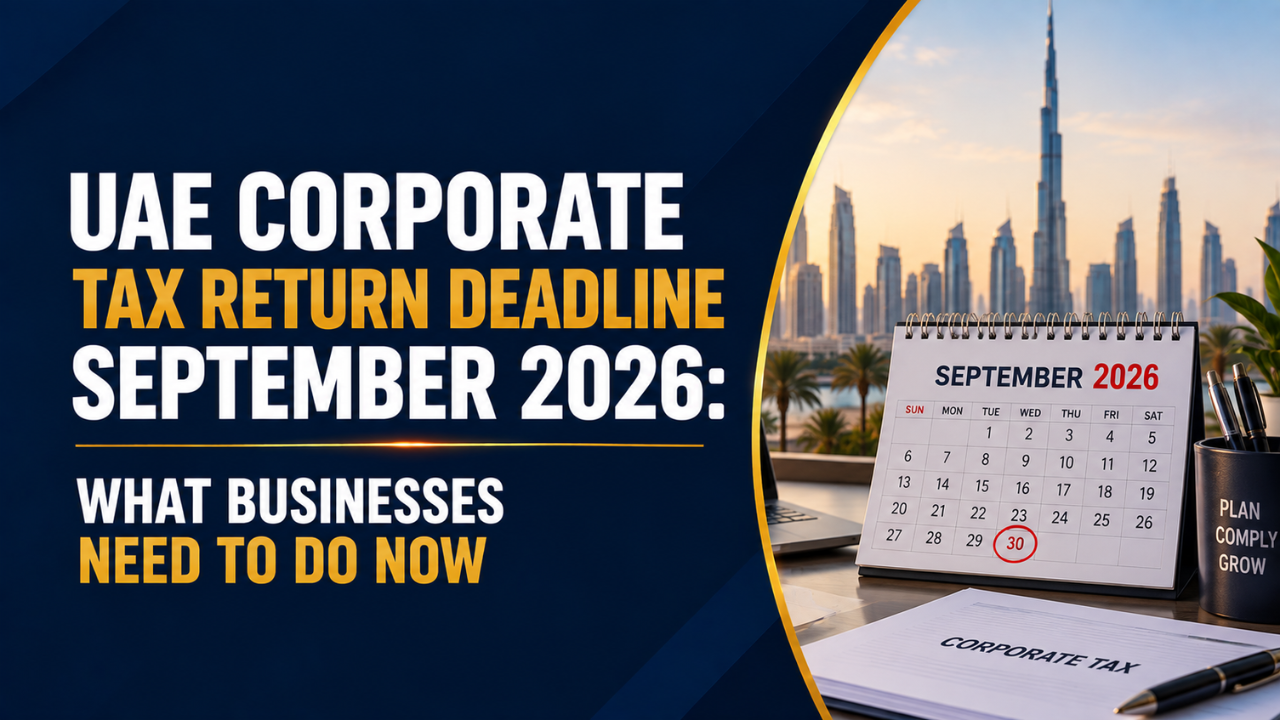
For businesses whose UAE Corporate Tax Tax Period ended on 31 December 2025, the Corporate Tax Return and any Corporate Tax due are generally required by 30 September 2026. The Federal Tax Authority (FTA) has reminded taxpayers to meet the deadline and avoid late-payment and late-filing consequences. The practical priority is to confirm your Tax Period, review your accounting records, reconcile taxable income and deductions, check your Corporate Tax registration details, and make sure the return and payment can be completed on time.
Why the September 2026 Deadline Matters
The UAE Corporate Tax regime has moved from preparation into an established compliance cycle. For companies with a calendar-year Tax Period, the first major filing cycle is now a real operational deadline rather than a future planning exercise. A business may have generated revenue correctly, maintained invoices and filed VAT returns, but still have a separate Corporate Tax obligation.
The FTA’s September 2026 reminder is particularly relevant for businesses with a 31 December 2025 Tax Period. The general filing and payment rule is within nine months from the end of the relevant Tax Period, subject to the taxpayer’s circumstances. That makes 30 September 2026 an important date for the affected calendar-year businesses.
Missing the deadline can create avoidable cost and administrative pressure. More importantly, last-minute filing makes it harder to identify accounting differences, related-party transactions, deductible-expense questions, tax adjustments or supporting-document gaps before submission.
Who Needs to Act Before 30 September 2026?
The deadline is not simply a deadline for every company incorporated in the UAE on the same day. Corporate Tax compliance depends on the taxpayer, Tax Period and applicable legislation. A business should therefore begin with its own FTA registration and Tax Period rather than assuming that another company’s deadline applies.
For the September 2026 deadline highlighted by the FTA, the key group is businesses with Tax Periods ending on 31 December 2025. If your Tax Period has a different year-end, your filing deadline can be different. Free Zone businesses also need to assess their position carefully rather than assuming that being in a Free Zone automatically removes filing obligations.
What to Check Before Filing
Start by confirming that the company’s legal name, Tax Registration Number and registration information are accurate. Then reconcile the accounts for the complete Tax Period. Revenue should agree to the accounting records, bank activity and major sales records. Expenses should be reviewed for business purposes, supporting invoices and Corporate Tax treatment.
A separate tax review should then identify items where accounting profit and taxable income do not have the same treatment. This can include non-deductible expenditure, exempt income, qualifying or non-qualifying income for a Qualifying Free Zone Person (QFZP), related-party matters and other adjustments required by the Corporate Tax rules.
Keep evidence together rather than searching for documents after the return has been prepared. A clean working file can include the trial balance, general ledger, financial statements, bank reconciliations, fixed-asset schedule, invoices, contracts, payroll information, related-party schedules and tax calculations.
Corporate Tax Payment Is a Separate Priority
Filing and payment should be treated as two connected but distinct tasks. If Corporate Tax is due, the business should have a payment plan before submitting the return. Waiting until the deadline day can create banking, approval or cash-flow problems.
Management should estimate the expected liability early, compare it with cash available, and obtain the internal approvals needed to make payment. If the tax calculation changes during final review, the company still has time to understand the impact rather than discovering it at the final hour.
Free Zone Businesses Should Not Assume 0% Tax Means No Filing
One of the most common misunderstandings is that a Free Zone company automatically has no Corporate Tax compliance. The UAE Corporate Tax system provides a special regime for a Qualifying Free Zone Person that meets the required conditions and can apply 0% to Qualifying Income, while the relevant rules can result in 9% treatment for non-qualifying taxable income. Eligibility and ongoing conditions matter.
A Free Zone company therefore needs to determine its actual status, income classification, substance and other compliance requirements. Filing obligations do not disappear simply because a company expects its tax liability to be zero.
Accounting Records and Documentation
Corporate Tax compliance depends on reliable accounting information. The FTA has also issued requirements relating to information to be maintained in accounting records and commercial books. Businesses should use this filing cycle to check whether their records are sufficiently detailed to support the return.
A practical test is simple: could an independent reviewer trace a material figure in the tax return back to the accounting records and then to supporting documentation? If not, the business should strengthen the record before filing.
A Practical September 2026 Preparation Checklist
- Confirm the company’s Tax Period and filing deadline.
- Confirm Corporate Tax registration information.
- Finalise the financial statements or tax-period accounts.
- Reconcile revenue, bank accounts and major balance-sheet items.
- Review expenses for deductibility and documentation.
- Identify exempt income and other tax adjustments.
- Review related-party transactions and supporting agreements.
- If in a Free Zone, assess QFZP conditions and income classification.
- Calculate expected Corporate Tax payable.
- Arrange payment and management approval before the deadline.
- Prepare the return in the FTA’s required format and review it before submission.
- Retain evidence of filing and payment and maintain supporting records.
Common Mistakes to Avoid
A frequent mistake is leaving the tax calculation until the final week. Another is treating accounting profit as automatically equal to taxable income. Businesses also sometimes assume that VAT compliance covers Corporate Tax compliance, or that a Free Zone licence automatically gives every type of income a 0% rate.
Another risk is poor document control. A tax return may be submitted, but if contracts, invoices, schedules or accounting explanations are missing, responding to a future query becomes more difficult. Good compliance is not just about pressing ‘submit’; it is about being able to support the figures afterward.
How AB Capital Can Help
AB Capital – UAE Business Setup can support UAE businesses with Corporate Tax registration, accounting and bookkeeping, tax compliance and broader business advisory. For companies approaching the September 2026 deadline, the objective should be to turn the filing into a controlled process: establish the correct Tax Period, organise records, review the tax position, prepare the return and plan payment.
For ongoing businesses, it is also worth building a monthly or quarterly tax-control process instead of repeating a rushed annual exercise. This can make future Corporate Tax calculations easier and improve management visibility over cash and compliance.
FAQs
What is the UAE Corporate Tax Return deadline in September 2026?
Do Free Zone companies need to file Corporate Tax returns?
Is Corporate Tax the same as VAT?
What should I do if my accounts are not finalized?
Need Help With Your UAE Corporate Tax Filing?
AB Capital can help you organise your Corporate Tax registration, accounting records, tax calculation and compliance process.
AB Capital Services FZC
Office No. 404, Al Tawhidi Building, Bank Street, Bur Dubai, UAE
Phone: +971 58 569 9300
Email: info@abcapital.ae
Website: abcapital.ae