

Introduction
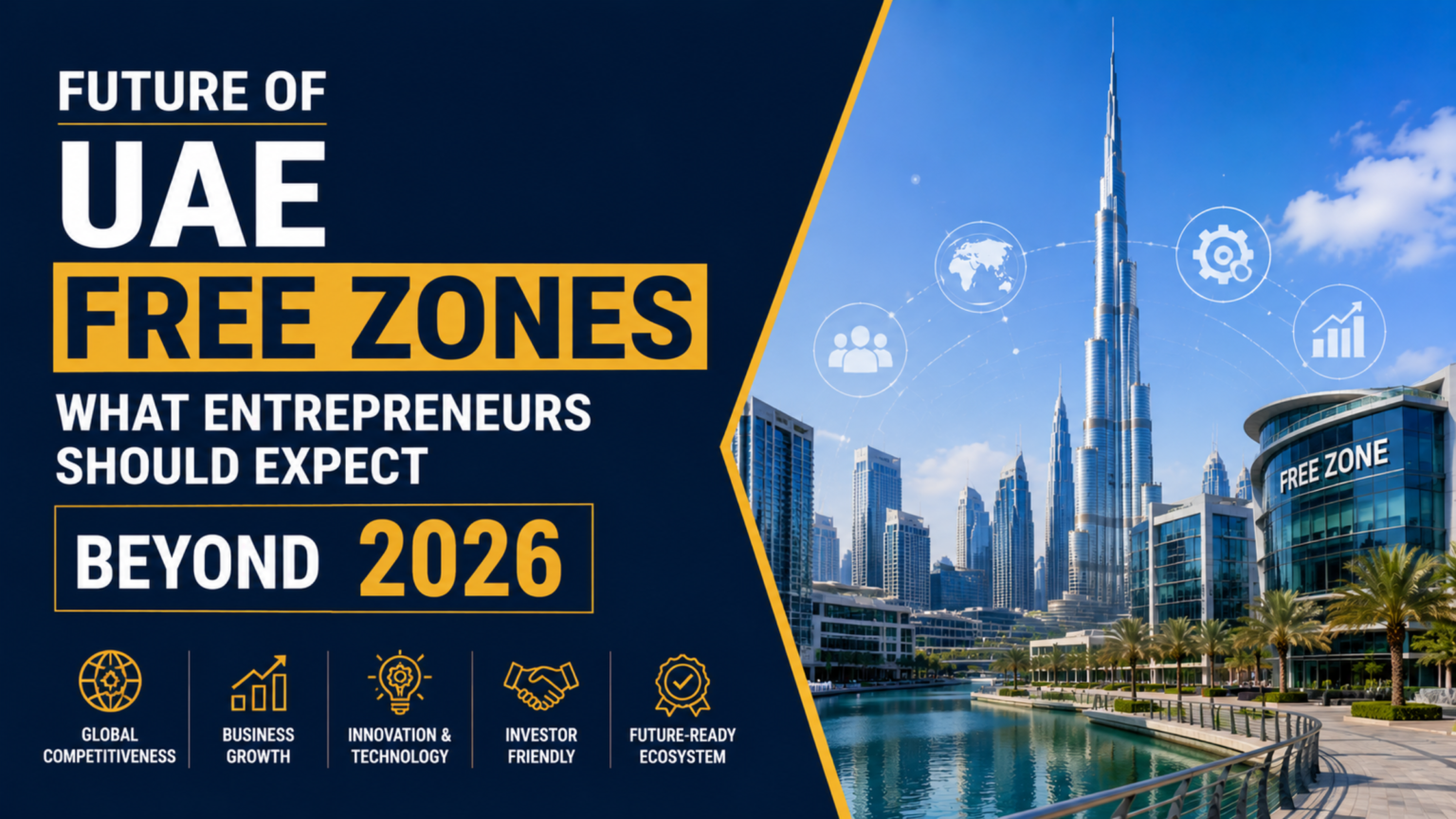
Over the last three decades, UAE Free Zones have transformed the country’s economy by attracting entrepreneurs, multinational companies, startups, manufacturers, and investors from around the world. What started as specialised economic zones designed to encourage foreign investment has evolved into a sophisticated business ecosystem supporting thousands of companies across industries such as technology, logistics, finance, healthcare, manufacturing, media, and professional services.
Today, the future of UAE Free Zones looks even more promising. Rather than competing solely on lower setup costs, Free Zones are increasingly focusing on innovation, digital transformation, sustainability, artificial intelligence, advanced infrastructure, and industry-specific ecosystems that help businesses grow in a rapidly changing global economy.
For entrepreneurs considering company formation in the UAE, understanding where Free Zones are heading is just as important as comparing today’s licence fees. The business decisions made now should support growth over the next five to ten years, not just the first year of operation.
This guide explores how UAE Free Zones are evolving, the opportunities they create for businesses, and what founders should consider when planning for the future.
What are UAE Free Zones?
A Free Zone is a designated economic area that offers businesses a specialised regulatory environment designed to encourage investment and economic growth.
Over the years, these zones have become home to businesses ranging from solo entrepreneurs and startups to Fortune 500 companies.
Depending on the Free Zone and business activity, companies may benefit from streamlined incorporation processes, flexible office solutions, industry-focused communities, and modern business infrastructure.
Today, the UAE has more than 40 Free Zones, each serving different industries and business models.
Why UAE Free Zones Have Become So Successful
The growth of Free Zones did not happen by chance. Their success is the result of long-term planning, investment in infrastructure, and policies designed to make the UAE attractive to international businesses.
Several factors continue to drive their popularity.
|
Key Strength |
Business Impact |
|
Strategic global location |
Easy access to Europe, Asia, Africa, and the Middle East |
|
Modern infrastructure |
Efficient business operations |
|
Digital government services |
Faster administrative processes |
|
Industry-specific ecosystems |
Better networking and collaboration |
|
International workforce |
Access to skilled professionals |
|
Stable regulatory environment |
Greater confidence for investors |
Together, these advantages have positioned the UAE as one of the world’s leading destinations for international business.
How UAE Free Zones Have Evolved
The role of Free Zones has changed significantly over the last two decades.
Earlier Focus
Initially, many Free Zones competed primarily on:
- Lower setup costs
- Basic licensing
- Warehousing
- Import and export support
Today’s Focus
Modern Free Zones increasingly compete by offering:
- Innovation ecosystems
- Technology infrastructure
- Startup support
- Digital incorporation
- Business accelerators
- Investment opportunities
- International partnerships
- Flexible workspaces
This evolution reflects the UAE’s broader vision of becoming a knowledge-based economy rather than relying solely on traditional industries.
Timeline: The Evolution of UAE Free Zones
|
Period |
Major Development |
|
1985–2000 |
Establishment of major Free Zones focused on trade and logistics |
|
2000–2015 |
Expansion into media, technology, healthcare, and finance |
|
2015–2020 |
Increased digitalisation and startup-friendly initiatives |
|
2020–2026 |
Greater emphasis on AI, fintech, sustainability, and digital government services |
|
Beyond 2026 |
Smart ecosystems, advanced technologies, and specialised innovation hubs |
The direction is clear: Free Zones are becoming centres of innovation rather than simply places to register a company.
Key Trends Shaping the Future of UAE Free Zones
Several long-term trends are already influencing how Free Zones operate.
1. Artificial Intelligence Will Drive Business Growth
Artificial Intelligence is rapidly becoming a key component of the UAE’s economic strategy.
Future Free Zones are expected to attract more companies involved in:
- AI software
- Automation
- Robotics
- Machine learning
- Data analytics
- Intelligent manufacturing
Businesses operating in these sectors are likely to benefit from increasingly specialised ecosystems and collaborative opportunities.
2. Digital Company Formation Will Become Even Simpler
Over recent years, the incorporation process has become increasingly digital.
Entrepreneurs can now complete many registration procedures online.
In the future, founders can expect:
- Faster approvals
- Improved digital identity verification
- Simplified documentation
- Integrated government services
- More efficient compliance processes
Digital transformation will continue reducing administrative complexity for new businesses.
3. Industry-Specific Free Zones Will Continue Growing
Rather than trying to attract every type of business, many Free Zones are becoming more specialised.
Examples include sectors such as:
- Healthcare
- Financial services
- Logistics
- Maritime
- Technology
- Media
- Manufacturing
- Education
This allows businesses to operate alongside suppliers, customers, investors, and partners within the same ecosystem.
Sustainability is Becoming a Business Advantage
Sustainability is no longer viewed solely as an environmental objective.
Increasingly, it is becoming a competitive business strategy.
Many Free Zones are investing in:
- Energy-efficient buildings
- Renewable energy
- Smart infrastructure
- Green logistics
- Sustainable industrial practices
Businesses that prioritise sustainability may benefit from stronger investor confidence and growing customer expectations.
Technology Will Reshape Everyday Business Operations
The future workplace will look very different from today’s.
Emerging technologies are expected to influence:
- Customer service
- Financial management
- HR processes
- Compliance
- Supply chain management
- Digital payments
- Business analytics
Companies operating within modern Free Zones will increasingly benefit from advanced digital infrastructure designed to support these changes.
Industries Expected to Grow the Fastest
Several sectors appear well-positioned for long-term growth within UAE Free Zones.
|
Industry |
Growth Outlook |
|
Artificial Intelligence |
Very High |
|
SaaS |
Very High |
|
FinTech |
Very High |
|
Healthcare Technology |
High |
|
Renewable Energy |
High |
|
E-commerce |
High |
|
Logistics Technology |
High |
|
Cybersecurity |
High |
|
Digital Marketing |
Medium-High |
|
Professional Services |
High |
While no industry is guaranteed success, these sectors align closely with the UAE’s long-term economic priorities.
Opportunities for International Entrepreneurs
For overseas founders, the future of UAE Free Zones presents several advantages.
These include:
- Access to international markets
- Flexible company formation
- Modern infrastructure
- Growing technology ecosystems
- Opportunities for regional expansion
- Access to global talent
- Improved digital government services
As more businesses adopt remote and international operating models, these advantages are likely to become even more valuable.
At a Glance
|
Trend |
Expected Impact |
|
AI adoption |
⭐⭐⭐⭐⭐ |
|
Digital government |
⭐⭐⭐⭐⭐ |
|
Sustainability |
⭐⭐⭐⭐☆ |
|
Startup ecosystems |
⭐⭐⭐⭐⭐ |
|
International investment |
⭐⭐⭐⭐⭐ |
|
Technology innovation |
⭐⭐⭐⭐⭐ |
Which UAE Free Zones Are Best Positioned for the Future?
While every Free Zone serves a purpose, some are better positioned to benefit from long-term economic trends such as digital transformation, artificial intelligence, advanced manufacturing, sustainability, and global trade.
The best choice isn’t necessarily the largest or the cheapest. It depends on your business activity, target customers, and future expansion plans.
Below is a general comparison of some well-known Free Zones based on their strengths.
|
Free Zone |
Best For |
Future Growth Outlook |
|
Dubai Multi Commodities Centre (DMCC) |
Trading, Technology, Professional Services |
⭐⭐⭐⭐⭐ |
|
Dubai Internet City |
Technology & SaaS |
⭐⭐⭐⭐⭐ |
|
Dubai Silicon Oasis |
AI, Innovation & Startups |
⭐⭐⭐⭐⭐ |
|
Jebel Ali Free Zone (JAFZA) |
Manufacturing & Logistics |
⭐⭐⭐⭐⭐ |
|
Meydan Free Zone |
Digital Businesses |
⭐⭐⭐⭐☆ |
|
IFZA |
SMEs & International Entrepreneurs |
⭐⭐⭐⭐☆ |
|
Sharjah Media City (SHAMS) |
Creative Businesses |
⭐⭐⭐⭐☆ |
|
RAKEZ |
Manufacturing & SMEs |
⭐⭐⭐⭐☆ |
Every Free Zone has different licensing options, office requirements, and industry focus. Entrepreneurs should evaluate long-term business objectives instead of selecting a jurisdiction based only on the initial registration cost.
Emerging Industries That Will Shape UAE Free Zones
As the UAE continues diversifying its economy, certain industries are expected to grow faster than others within Free Zones.
Businesses operating in these sectors may benefit from increasing investment, stronger ecosystems, and access to specialised infrastructure.
Artificial Intelligence
AI is expected to remain one of the UAE’s highest-priority sectors.
Potential business opportunities include:
- AI software
- Automation platforms
- Machine learning solutions
- AI consulting
- Robotics
- Predictive analytics
Financial Technology (FinTech)
Digital payments, embedded finance, blockchain applications, and financial software continue creating opportunities for startups and established companies.
Healthcare & HealthTech
Growing populations and increasing healthcare investments are driving demand for:
- Digital healthcare
- Telemedicine
- Medical technology
- Healthcare software
- Wellness platforms
Green Technology
Sustainability initiatives continue encouraging innovation in:
- Renewable energy
- Smart buildings
- Carbon management
- Water conservation
- Waste management
E-Commerce & Digital Retail
Online businesses continue expanding throughout the Middle East.
Demand remains strong for:
- Online marketplaces
- Logistics technology
- Payment solutions
- Warehouse automation
- Customer experience software
Challenges Businesses Should Prepare For
While the future of UAE Free Zones is promising, entrepreneurs should also prepare for changing business requirements.
Growth often brings higher expectations regarding governance, compliance, and operational standards.
Some areas businesses should monitor include:
- Regulatory updates
- Accounting requirements
- Corporate Tax obligations
- Data protection practices
- Cybersecurity measures
- Banking due diligence
- International reporting standards
Preparing early helps businesses adapt smoothly as regulations evolve.
How Artificial Intelligence Will Change Business Setup
Artificial Intelligence is already transforming how businesses operate, and Free Zones are likely to integrate AI into many administrative and commercial processes.
Possible developments include:
- Faster document verification
- AI-assisted licensing applications
- Intelligent customer support
- Automated compliance reminders
- Predictive business analytics
- Smart government services
These improvements could reduce administrative workloads and improve efficiency for entrepreneurs.
Why Industry Ecosystems Will Become More Important
One of the biggest advantages of specialised Free Zones is the opportunity to work within an established business community.
Companies often benefit from being close to:
- Customers
- Suppliers
- Investors
- Service providers
- Technology partners
- Industry events
- Networking opportunities
As industries become increasingly specialised, these ecosystems are likely to create additional collaboration and innovation opportunities.
Future Opportunities for International Entrepreneurs
International founders continue choosing the UAE because it offers more than favourable business policies.
It provides access to one of the world’s most connected commercial environments.
Future advantages may include:
- Easier digital company formation
- More specialised Free Zones
- Stronger startup ecosystems
- Better international connectivity
- Growing venture capital activity
- Increasing demand for technology businesses
- Improved digital government services
These developments make the UAE attractive for entrepreneurs looking beyond their domestic markets.
Pros and Cons of Setting Up in a UAE Free Zone
|
Pros |
Cons |
|
Industry-focused business communities |
Different Free Zones have different rules |
|
Modern infrastructure |
Choosing the wrong jurisdiction may limit flexibility |
|
Streamlined company formation |
Some activities require additional approvals |
|
Strong international reputation |
Banking requirements vary |
|
Access to specialised ecosystems |
Long-term planning is essential |
Overall, Free Zones continue offering significant advantages for startups, SMEs, and international businesses when the right jurisdiction is selected.
Common Myths About UAE Free Zones
Many entrepreneurs rely on outdated information when researching company formation.
Let’s address a few common misconceptions.
|
Myth |
Reality |
|
Every Free Zone is the same |
Each has different industries, licensing options, and regulations. |
|
The cheapest licence is always the best |
Long-term value often matters more than initial cost. |
|
Free Zones are only for foreign companies |
Businesses of different sizes and ownership structures operate in Free Zones. |
|
Company formation is the final step |
Banking, compliance, accounting, and ongoing obligations remain essential. |
|
Future growth doesn’t matter during setup |
Choosing the right structure today can reduce future restructuring costs. |
How to Choose a Future-Ready Free Zone
Instead of asking:
“Which Free Zone is the cheapest?”
Ask yourself:
Business Questions
- What industry am I in?
- Who are my customers?
- Will I hire employees?
- Do I need warehouse facilities?
- Will I raise investment?
- Do I expect international growth?
Operational Questions
- What type of office do I require?
- Will I need residence visas?
- What banking services will I use?
- What are my compliance obligations?
- How important is scalability?
Thinking beyond the first year helps build a stronger foundation for long-term success.
Mainland or Free Zone?
Confused between UAE Mainland and Free Zone company setup? Answer 5 quick questions and discover which business structure saves you more money and suits your goals.
How AB Capital Helps Businesses Choose the Right Free Zone
Selecting a Free Zone involves more than comparing licence fees. Entrepreneurs need to understand how each jurisdiction aligns with their business activity, operational requirements, banking expectations, visa plans, and future expansion goals.
AB Capital Services, Dubai works with startups, SMEs, multinational companies, and international investors to evaluate suitable Free Zones across the UAE. The team assists with company formation, business activity selection, corporate bank account guidance, visa planning, accounting, tax compliance, and ongoing business support. Rather than focusing solely on affordability, the objective is to help businesses establish a structure that supports sustainable long-term growth.
Frequently Asked Questions
Are UAE Free Zones still a good option for new businesses?
Yes. Free Zones remain one of the most popular options for entrepreneurs due to their modern infrastructure, industry-specific ecosystems, and efficient company formation processes.
Will UAE Free Zones continue growing after 2026?
Current economic initiatives, investments in technology, and continued focus on innovation indicate that Free Zones are likely to remain an important part of the UAE’s long-term economic strategy. However, individual industries and regulations will continue evolving over time.
Which industries have the strongest future potential?
Artificial intelligence, SaaS, fintech, healthcare technology, logistics, renewable energy, cybersecurity, advanced manufacturing, and digital services are among the sectors expected to see continued growth.
Will digital company formation become easier?
Many government services are already available online, and continued investment in digital transformation suggests that business registration and compliance processes are likely to become increasingly efficient.
How do I choose the right Free Zone?
Consider your business activity, customer base, operational requirements, office needs, banking expectations, visa plans, and long-term growth strategy. Comparing only the setup cost may not lead to the best decision.
Final Thoughts
The future of UAE Free Zones extends far beyond offering affordable company formation. They are evolving into innovation-driven business ecosystems that support entrepreneurs, startups, and multinational companies through technology, specialised infrastructure, digital government services, and international connectivity.
For business owners planning to establish a company in the UAE, success will depend not only on choosing a Free Zone with competitive pricing but also on selecting one that aligns with future growth, operational flexibility, and industry requirements.
As the UAE continues investing in artificial intelligence, sustainability, advanced manufacturing, fintech, logistics, and digital transformation, Free Zones are expected to play an increasingly important role in attracting global investment and supporting the next generation of businesses.
The most successful entrepreneurs will be those who look beyond today’s setup costs and choose a business structure that can adapt to tomorrow’s opportunities. By planning with a long-term perspective, founders can position their companies to benefit from the continued evolution of one of the world’s most dynamic business environments.