

Getting your DMCC crypto license feels like crossing the finish line. Then you try to open a bank account and discover you’re actually at the starting blocks.
This is the reality 650+ crypto companies in DMCC face: you’re licensed, legal, and ready to operate, but UAE banks treat you like radioactive waste. Your trade license says “cryptocurrency trading” and internal risk systems auto-reject before a human even reads your application.
After helping crypto founders navigate this exact problem through 2024-2026, I’m sharing what actually works—not marketing brochures, but real acceptance data from founders who’ve successfully banked DMCC crypto entities in the current regulatory environment.

Why Your DMCC License Doesn’t Solve the Banking Problem
DMCC is a free zone authority. It issues licenses for cryptocurrency trading, crypto asset management, crypto advisory, and distributed ledger technology services. But here’s what DMCC cannot do: force UAE banks to accept your company as a client.
The structural problem is this: to activate your DMCC license, you need to deposit minimum share capital (AED 50,000 for most crypto structures) into a corporate bank account. That account must be in your company’s exact legal name with your trade license reflecting virtual asset activities.
UAE banks, meanwhile, categorize crypto companies as “enhanced risk” regardless of licensing. Not because your business violates law—DMCC and VARA have built legitimate regulatory frameworks. But because bank compliance departments operate on internal risk policies written before 2023, when crypto regulation barely existed in the UAE.
The disconnect: Regulators say you’re compliant. Banks say you’re high-risk. Your license gets you regulatory approval but not financial access.
The Three Types of DMCC Crypto Licenses (Banks Care About This)
Before approaching any bank, understand which category you fall into. Banks assess these differently and acceptance rates vary dramatically.
Type 1: Non-Regulated Crypto Activities
What it covers:
- Blockchain software development
- Crypto consulting and advisory (not custody or trading client funds)
- DLT research and educational services
- NFT marketplace infrastructure (platform only, not dealing)
Banking difficulty: Moderate
These companies typically don’t trigger VARA requirements because they’re not handling client funds or virtual assets directly. Banks still apply enhanced due diligence, but you’re not flagged as a Virtual Asset Service Provider (VASP).
Success rate: 40-60% with proper documentation
Type 2: Proprietary Crypto Trading (VARA NOC Required)
What it covers:
- Trading crypto assets using only company’s own funds
- No client-facing services
- No custody of third-party assets
- Activity code 6599 92 in DMCC license
Banking difficulty: High
This category requires a VARA No Objection Certificate even though you don’t need full VARA licensing. Banks struggle to understand “proprietary trading”—they worry it’s a backdoor to client services.
Key distinction: If you execute trades at another party’s initiation or provide any portfolio management (even to friends/family), you’ve crossed into regulated territory.
Success rate: 25-40% depending on capital proof
Type 3: Fully VARA-Licensed VASPs
What it covers:
- Cryptocurrency exchanges
- Custody services for client assets
- Broker-dealer operations
- Virtual asset payment services
Banking difficulty: Extreme
Full VARA licensing means AED 100,000+ minimum capital, appointed Money Laundering Reporting Officer (MLRO), comprehensive AML/KYC frameworks, and ongoing regulatory reporting. Banks know these businesses carry maximum regulatory scrutiny.
Success rate: 15-30% (requires significant capital and operational substance)
Which UAE Banks Actually Accept DMCC Crypto Companies (2026 Data)
Based on actual account openings from Q4 2025 through Q1 2026, here’s the real landscape:
Tier 1: Banks With Structured Crypto Onboarding
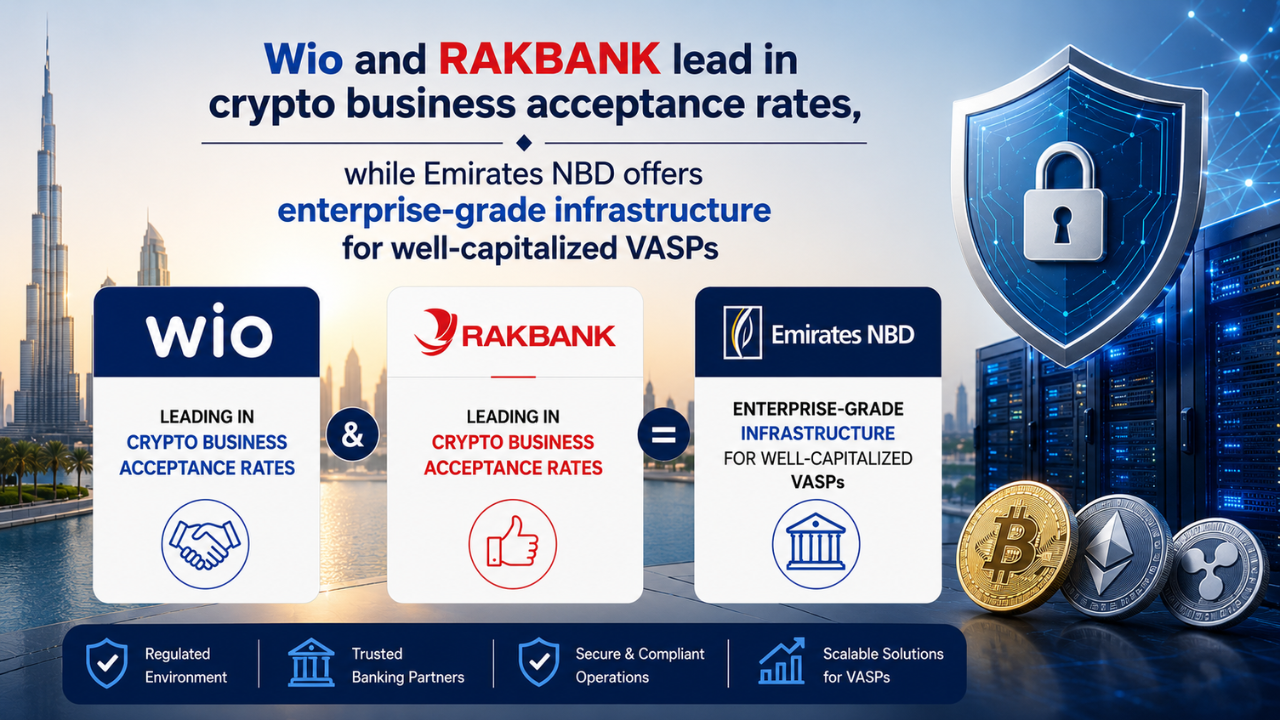
Wio Bank (Digital-First Leader)
- Acceptance rate: 55-65% for licensed entities
- Timeline: 5-10 business days average
- Minimum deposit: AED 50,000-100,000
- What they require:
- Full DMCC or VARA license documentation
- Comprehensive AML/KYC policy document
- Source of wealth declarations for all shareholders
- Clear business model explanation (non-technical language)
- 12-month financial projections
Why Wio works: Purpose-built for Web3 businesses. They launched a dedicated “Crypto Business” desk in late 2025 specifically for licensed entities. Their digital infrastructure handles enhanced due diligence without 6-week manual review processes.
Limitations: Not suitable for VASPs requiring high-volume fiat-to-crypto on-ramps. Better for operational accounts (payroll, expenses, vendor payments).
RAKBANK (Progressive Traditional Bank)
- Acceptance rate: 45-55% for licensed entities
- Timeline: 10-15 business days
- Minimum deposit: AED 100,000-250,000
- What they require:
- DMCC license with clear activity scope
- VARA NOC or license (if applicable)
- Detailed transaction flow diagrams
- Customer Due Diligence (CDD) procedures
- Directors must be UAE residents (preferred but not absolute)
Why RAKBANK works: They partnered with Bitpanda (VARA-licensed) and operate dedicated crypto desk. Internal compliance teams understand the difference between custody services and advisory businesses.
Limitations: Higher balance requirements than neobanks. Strong preference for companies with physical office presence (not just flexi-desk).
Emirates NBD (Enterprise-Grade Banking)
- Acceptance rate: 35-45% for licensed entities
- Timeline: 15-25 business days
- Minimum deposit: AED 200,000-500,000 (some sources cite AED 4 million for crypto-active accounts)
- What they require:
- Complete VARA licensing (strongly preferred)
- Demonstrated operational substance in UAE
- Detailed source of funds documentation
- Transaction monitoring procedures
- Ongoing compliance reporting commitment
Why Emirates NBD works: UAE’s largest bank with institutional infrastructure. When you get approved, you have access to full treasury services, multi-currency accounts, and international wire capabilities that neobanks lack.
Limitations: Extremely rigorous enhanced due diligence. Expect detailed interviews with compliance officers. Not suitable for early-stage or small crypto ventures.
Tier 2: Selective Case-by-Case Banks
Mashreq Bank
- Acceptance rate: 30-40%
- Historically more progressive on fintech/digital assets
- Has banking relationships with DIFC-licensed entities
- Requires exceptional compliance documentation
- Strong board governance and clear business model
First Abu Dhabi Bank (FAB)
- Acceptance rate: 25-35%
- Focus on large-scale institutional crypto businesses
- Partnerships with blockchain infrastructure companies
- High capital requirements (AED 500,000+ minimum)
- Preference for companies with international backing
Zand Bank (Digital Custody Specialist)
- Acceptance rate: 40-50% for specific use cases
- Regulated crypto custodian in ADGM
- Bridges traditional finance (TradFi) and DeFi
- Suitable for institutional and fintech clients
- Still scaling retail crypto business acceptance
Tier 3: Generally Unavailable (2026 Reality)
HSBC UAE: Extremely conservative on crypto. Rare acceptances even with full VARA licensing.
Standard Chartered: Global compliance policies restrict most virtual asset businesses.
Citibank UAE: Similar to HSBC—institutional-only with exceptional circumstances.
Abu Dhabi Commercial Bank (ADCB): Case-by-case but low acceptance rate.
The Documentation That Actually Gets You Approved
Banks don’t reject DMCC crypto companies because they’re illegal—they reject them because documentation doesn’t satisfy internal compliance frameworks. Here’s what moves applications from “pending review” to “approved”:
Core Corporate Documents
1. Trade License Package
- DMCC trade license (certified copy)
- Certificate of Incorporation
- Memorandum and Articles of Association (MOA)
- Share certificates for all shareholders
- Board resolution authorizing account opening (specific to the bank)
Standard requirement—but ensure activity description on license is crystal clear. Avoid vague terminology like “blockchain services”—specify “blockchain software development” or “crypto asset management (proprietary trading).”
Business Operations Evidence
2. Comprehensive Business Plan (This Is Critical)
Most founders submit 5-page “executive summaries.” Banks need 15-25 pages covering:
- Detailed business model: How do you generate revenue? Who are your customers? What crypto assets do you trade/manage/advise on?
- Market analysis: Target market size, competitive landscape, why UAE/DMCC specifically
- Revenue projections: 3-year forecasts with clear assumptions
- Operational structure: Who does what? Where are decisions made? Where are assets held?
- Technology infrastructure: Trading platforms, custody solutions, security protocols
- Growth strategy: Roadmap for next 12-24 months
Key insight: Banks want to see genuine business operations, not shell companies. Demonstrate substance.
3. Source of Funds Documentation
For every AED deposited, banks need to trace origin:
- Personal wealth: Tax returns, employment contracts, bank statements showing savings accumulation
- Investment income: Brokerage statements, capital gains documentation, dividend records
- Business profits: Audited financials from previous ventures, sale agreements
- External investment: Term sheets, investment agreements, investor identity verification
Common mistake: Vague statements like “accumulated savings.” Banks need specific paper trail.
Compliance Framework Documentation
4. Anti-Money Laundering (AML) Policy
Your AML policy must be specific to your DMCC crypto business—not a template downloaded from the internet.
Required sections:
- Risk assessment methodology for your specific activities
- Customer due diligence (CDD) procedures with examples
- Enhanced due diligence (EDD) triggers
- Transaction monitoring thresholds and red flags
- Suspicious activity reporting procedures
- Record retention policies (minimum 5 years per UAE law)
- Training requirements for employees
Pro tip: Reference VARA’s AML/CFT Guidelines in your policy. Show you understand UAE regulatory expectations.
5. Know Your Customer (KYC) Procedures
Document how you will KYC your clients (if applicable):
- Identity verification process (passport, Emirates ID, utility bills)
- Beneficial ownership identification
- Politically Exposed Persons (PEP) screening
- Sanctions list screening (OFAC, UN, EU, local)
- Ongoing monitoring and refresh cycles
Even if you’re proprietary trading (no clients), banks want to see you understand KYC principles.
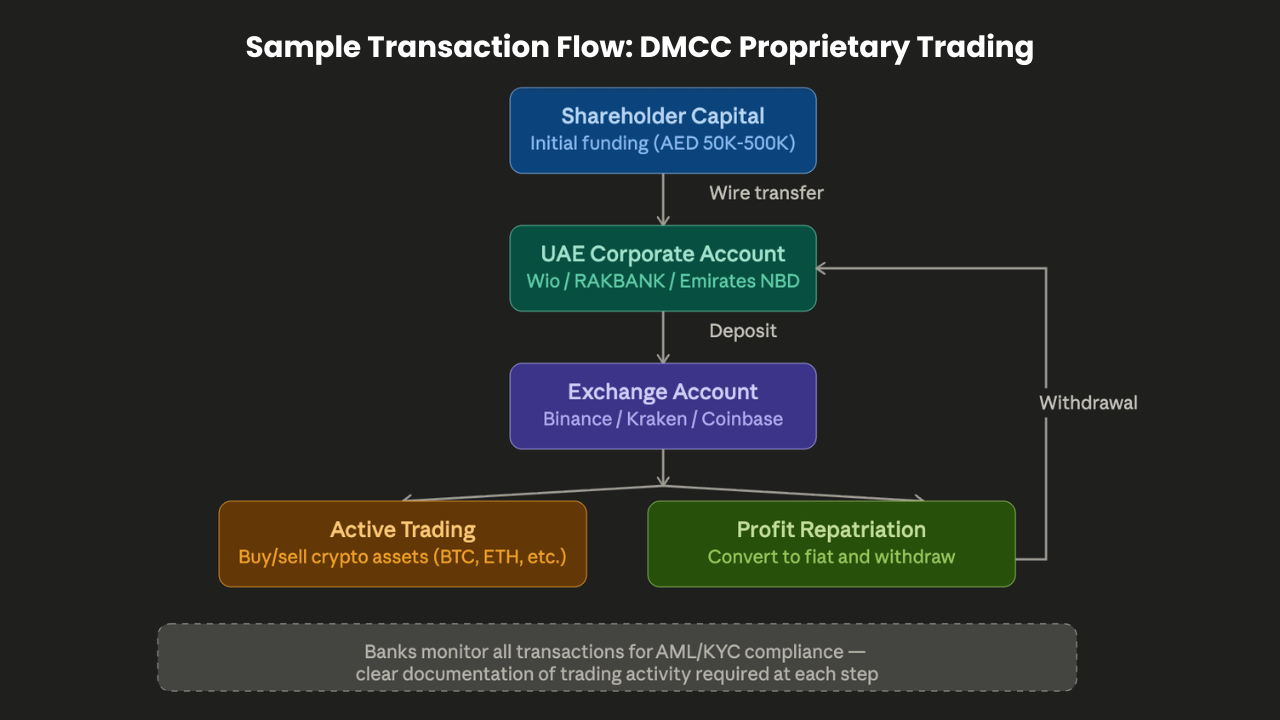
6. Transaction Flow Diagrams
Visual representation of how funds move:
- Customer deposits (if applicable) → Your custody solution → Trading venues → Settlement → Customer withdrawals
- Proprietary capital → Exchange accounts → Trading activity → Profit repatriation
Banks need to see: Where do funds come from? Where do they go? Which intermediaries are involved? Are there cross-border movements?
Enhanced Due Diligence Preparation
7. Shareholder/Director Background
For each beneficial owner and director:
- Certified passport copy
- UAE residence visa and Emirates ID (if applicable)
- Curriculum vitae demonstrating relevant experience
- Professional references
- Criminal background check from home country (sometimes required)
- Source of wealth statement
- Previous business track record
Red flags banks watch for:
- Shareholders from high-risk jurisdictions (FATF grey/black list countries)
- Recent incorporation with no track record
- Nominee shareholders or complex ownership structures
- Directors with no crypto/finance/tech background
8. Proof of UAE Operational Substance
Banks increasingly require evidence you’re genuinely operating in UAE, not using DMCC as offshore vehicle:
- Office lease agreement (Ejari for mainland, tenancy for DMCC office/flexi-desk)
- Utility bills (DEWA electricity/water)
- Employee contracts for UAE-based staff
- Emirates ID for key personnel
- UAE mobile phone numbers
- Evidence of business activity: client contracts, vendor agreements, service invoices
Why this matters: Economic Substance Regulations (ESR) require companies to demonstrate real activity where they’re licensed. Banks check this.
VARA-Specific Documentation (If Applicable)
9. VARA Licensing Package
If you’re a regulated VASP:
- Complete VARA license or In-Principle Approval
- Initial Disclosure Questionnaire (IDQ) submission
- Authorization to Innovate (ATI) confirmation (if applicable)
- VARA NOC for proprietary trading companies
- Compliance monitoring reports
- Appointed MLRO credentials
10. Technical Security Documentation
For companies handling virtual assets:
- Cybersecurity policy and procedures
- Wallet custody arrangements (hot/cold storage ratios)
- Multi-signature authorization protocols
- Disaster recovery and business continuity plans
- Insurance coverage (if applicable)
- Third-party security audits (penetration testing, vulnerability assessments)
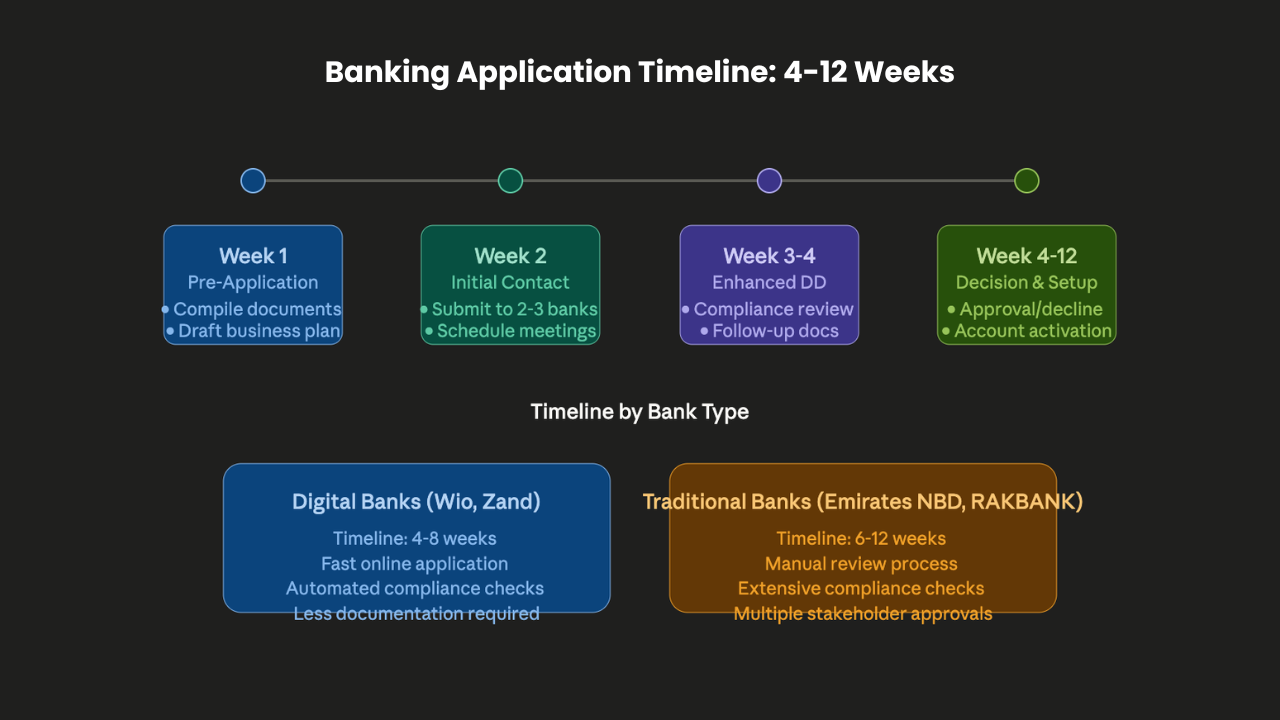
The Banking Application Process: Week-by-Week Timeline
Week 1: Pre-Application Preparation
Day 1-2: Compile all corporate documents, obtain certified copies, prepare board resolutions.
Day 3-5: Draft comprehensive business plan. This takes longer than founders expect—allocate proper time.
Day 6-7: Prepare AML/KYC policy documents. Review against VARA guidelines and FATF recommendations.
Pro tip: Before submitting to any bank, have documents reviewed by UAE compliance consultants familiar with the crypto sector. Cost: AED 3,000-5,000. Saves weeks of back-and-forth.
Week 2: Initial Bank Contact
Choose 2-3 banks simultaneously. Don’t wait for rejection from Bank A before applying to Bank B.
For digital banks (Wio, Zand):
- Online application through business banking portal
- Upload all documentation digitally
- Receive initial assessment within 48-72 hours
For traditional banks (RAKBANK, Emirates NBD, Mashreq):
- Contact relationship manager or business banking team
- Schedule preliminary meeting (often virtual)
- Present business overview before formal application
- Receive feedback on documentation gaps
Common outcome: Bank requests additional documents or clarifications. This is normal. Respond within 24-48 hours to maintain momentum.
Week 3-4: Enhanced Due Diligence Phase
Bank compliance reviews:
- Source of funds verification
- Shareholder background checks
- Business model assessment
- Risk scoring against internal policies
Possible bank requests:
- Additional supporting documents
- Clarification calls with founders/directors
- Amendment to business plan or AML policy
- Higher minimum deposit commitment
Your response strategy:
- Provide documents immediately when requested
- Anticipate questions and provide context proactively
- Demonstrate you understand compliance concerns
- Show operational substance (office photos, team photos, activity evidence)
Week 4-6: Decision and Account Opening
Approval scenarios:
Best case: Conditional approval with account opening appointment scheduled.
Requirements:
- Initial deposit (wire transfer from existing account in founder’s name)
- In-person verification meeting (sometimes virtual for digital banks)
- Final KYC documentation
- Signing of account opening forms and terms
Moderate case: Approval in principle pending additional information.
Action: Provide requested information immediately. Don’t let momentum die.
Worst case: Application declined.
Response: Request specific declination reason (in writing if possible). Address concerns. Reapply to different banks with strengthened application.
Account activation: 3-5 business days after approval and initial deposit.
Total realistic timeline: 4-8 weeks for digital banks; 6-12 weeks for traditional banks.
Why Banks Still Reject Licensed DMCC Crypto Companies
Even with perfect documentation, some applications fail. Understanding why helps you avoid these pitfalls:
🚩Red Flag #1: Insufficient Capital
Bank concern: Company claims to trade crypto but has minimal capital.
Why it matters: If you’re licensed for “crypto asset management” but only depositing AED 50,000 minimum share capital, banks question viability. Real trading firms have capital.
Solution:
- Demonstrate realistic capital for stated business model
- If early-stage, focus on advisory/consulting activities requiring less capital
- Show investor commitments or funding roadmap
🚩Red Flag #2: Opaque Ownership Structure
Bank concern: Complex ownership through multiple layers, nominee shareholders, or opaque beneficial ownership.
Why it matters: UAE’s Ultimate Beneficial Ownership (UBO) regulations require transparency. Banks must identify and verify all persons who own 25%+ of company.
Solution:
- Maintain simple, transparent ownership structure
- All shareholders directly identifiable with clear source of wealth
- Avoid nominee arrangements or offshore holding structures (unless extremely well documented)
🚩Red Flag #3: No Operational Substance
Bank concern: Virtual office only, no employees, no evidence of actual business activity.
Why it matters: Economic Substance Regulations (ESR) require genuine operations. Banks don’t want to facilitate shell companies.
Solution:
- Hire at least 1-2 employees in UAE (even part-time)
- Maintain physical office (even small serviced office)
- Show evidence of business activity: contracts, invoices, service delivery
🚩Red Flag #4: Unrealistic Business Projections
Bank concern: Business plan shows explosive growth with no supporting rationale or implausibly high margins.
Why it matters: Unrealistic projections signal either inexperience or intentional misrepresentation.
Solution:
- Conservative, well-researched projections
- Clear assumptions with market data support
- Explain growth drivers specifically
- Show understanding of competitive landscape and challenges
🚩Red Flag #5: High-Risk Jurisdictions
Bank concern: Founders, shareholders, or target customers from FATF high-risk countries.
Why it matters: Banks must apply enhanced due diligence for connections to high-risk jurisdictions. Some banks simply decline to avoid compliance burden.
Solution:
- If shareholders from high-risk countries, provide extensive background documentation
- Consider restructuring ownership if possible
- Demonstrate robust AML controls specifically addressing jurisdictional risks
- Focus on customers from low-risk jurisdictions initially
🚩Red Flag #6: Poorly Defined Business Model
Bank concern: Vague explanations like “blockchain consulting” or “crypto trading” without specifics.
Why it matters: Banks need to understand exactly what you do to risk-score appropriately.
Solution:
- Be extremely specific about activities
- Provide examples of services or trades
- Name trading platforms, custody providers, technology partners
- Show sample client contracts or service agreements (anonymized)
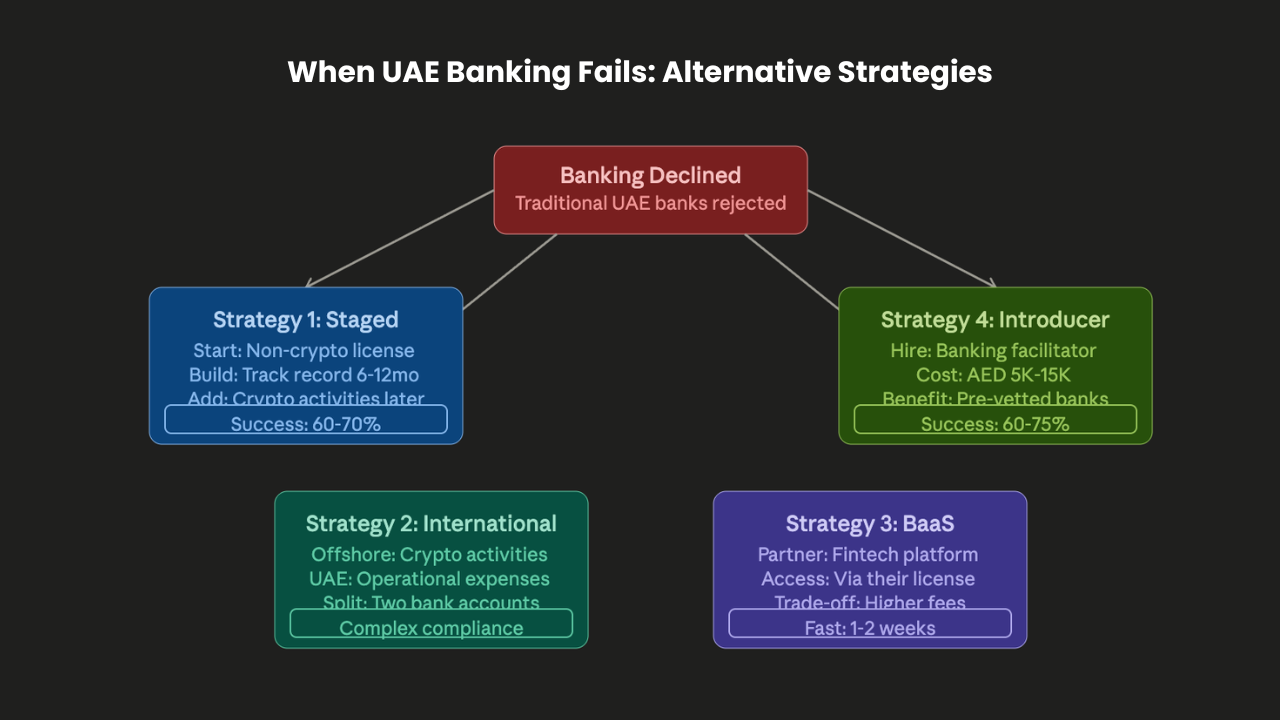
The Alternative Banking Strategies (When Traditional Banking Fails)
Strategy 1: Staged Approach
Start with non-crypto license, then upgrade:
- Obtain DMCC license for generic tech activity (software development, business consulting)
- Open bank account with this safer license
- Build operational track record (6-12 months)
- Amend license to add crypto activities
- Notify bank of license change with evidence of compliant operations
Pros: Easier initial banking access
Cons:
- Must genuinely conduct non-crypto activities initially (not a facade)
- Bank may still require new enhanced due diligence when adding crypto
- Could face account closure if perceived as deceptive
Suitability: Companies with genuine non-crypto revenue stream alongside crypto ambitions
Strategy 2: International Banking + UAE Fintech Partnerships
Use offshore account for crypto activities + UAE account for operational expenses:
- Open corporate account in crypto-friendly jurisdiction (e.g., Singapore, Switzerland, Lithuania EMI)
- Maintain separate UAE account for local expenses (payroll, rent, utilities)
- Partner with licensed UAE VASP for fiat-crypto on-ramps when needed
Pros: Separates high-risk activities from UAE banking relationship
Cons:
- Increased compliance complexity (multiple jurisdictions)
- Higher banking costs
- Potential tax implications
- Doesn’t satisfy “UAE bank account” requirement for some business purposes
Suitability: International businesses with significant non-UAE operations
Strategy 3: Banking-as-a-Service (BaaS) Partnerships
Leverage fintech infrastructure partners:
Some UAE-licensed fintechs offer embedded banking solutions where they hold the underlying bank relationship and provide you access through their platform.
Pros: Faster onboarding than direct bank applications
Cons:
- Your funds held in pooled account (not your direct bank account)
- Higher transaction fees
- Less control and transparency
- Partner’s license could be revoked, impacting your operations
Suitability: Very early-stage companies willing to pay premium for fast access
Strategy 4: Professional Introducer Services
Engage specialized banking facilitators:
Some consultancies maintain relationships with bank decision-makers and can facilitate introductions for crypto companies.
How it works:
- Review your documentation and strengthen weak areas
- Identify appropriate banks for your specific business model
- Facilitate introduction to relationship manager
- Provide ongoing support through application process
Cost: AED 5,000-15,000 (one-time)
Pros:
- Higher success rate (60-75% vs 35-40% DIY)
- Faster timeline (banks prioritize introduced applications)
- Pre-screening prevents wasted applications to unsuitable banks
Cons:
- Upfront cost
- Not guaranteed success
- Still requires comprehensive documentation
Suitability: Well-capitalized businesses prioritizing time-to-market
What Changes in 2026: Banking Getting Easier or Harder?
Positive Developments
Crypto-dedicated banking desks: Wio and RAKBANK launched specialized teams in late 2025. Other banks are likely following in 2026.
Improved VARA clarity: As VARA matures and more companies get licensed, banks gain comfort with regulated space.
Stablecoin framework: UAE Central Bank’s 2026 stablecoin regulations bringing additional legitimacy to the digital asset sector.
Bank partnerships with VASPs: Emirates NBD partnered with Aquanow and Zodia Custody. More bank-crypto partnerships expected.
Negative Pressures
Increased regulatory scrutiny: CARF (Crypto-Asset Reporting Framework) implementation coming, banks may tighten requirements.
Global banking consolidation: International banks exiting high-risk segments could reduce options.
De-risking trends: Some banks are completely exiting crypto rather than investing in enhanced compliance.
Higher capital requirements: Banks asking for AED 250,000-500,000 minimums vs AED 50,000-100,000 previously.
Net outlook for 2026: Moderately improving for well-documented, well-capitalized crypto companies with genuine operations. Becoming harder for undercapitalized or substance-light entities.
Real Talk: What Founders Need to Accept
After working with 40+ crypto founders on UAE banking (15 successful, 25 ongoing/failed), here’s the unvarnished reality:
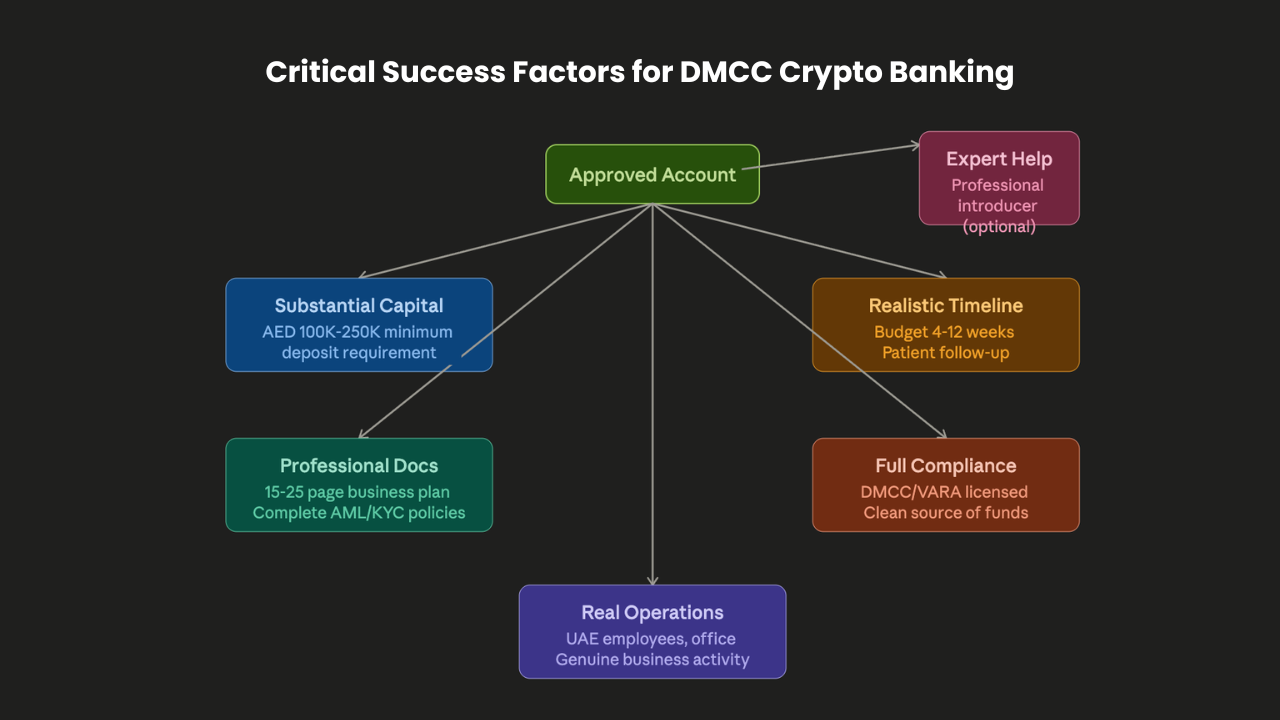
1. Your DMCC license is necessary but not sufficient
The license proves regulatory compliance. It doesn’t prove business viability, operational substance, or low money laundering risk. Banks assess all of these independently.
2. Banking will take longer than licensing
DMCC license: 2-4 weeks. Banking: 6-12 weeks average. Budget accordingly.
3. You need significantly more capital than minimum requirements
Minimum share capital is AED 50,000. Realistic banking threshold: AED 100,000-250,000 for initial deposit plus operating capital. Budget AED 200,000-400,000 total liquid capital for first year.
4. Not all DMCC crypto companies can be banked in UAE
Some business models are currently too high-risk for UAE banks regardless of licensing. International banking may be necessary.
5. Documentation quality matters more than you think
A 25-page professionally prepared business plan moves applications forward. A 5-page template gets declined. Invest in quality documentation.
6. Having the right network helps significantly
Founders with existing UAE banking relationships, reputable investors, or professional advisors get banked faster. Cold applications from unknown entities face the highest scrutiny.
7. Be prepared to adjust your business model
If you’re licensed for custody but banks won’t accept that, can you pivot to advisory? Sometimes business model flexibility matters more than ideal activities.
The Setup Costs: Banking Isn’t Free
Budget for these banking-related expenses:
| Cost Item | Amount (AED) | Notes |
| Business plan preparation | 3,000-8,000 | Professional writer with crypto knowledge |
| AML/KYC policy documentation | 2,500-6,000 | Compliance consultant specializing in crypto |
| Legal review | 2,000-5,000 | UAE lawyer reviewing application package |
| Banking introducer | 5,000-15,000 | Optional but significantly improves success rate |
| Document certification | 500-1,500 | Notarization and attestation |
| Initial bank deposit | 100,000-500,000 | Varies by bank and business type |
| Ongoing bank fees | 2,000-5,000/year | Monthly maintenance, transaction fees |
Total first-year banking costs: AED 115,000-540,000
What founders underestimate: The “soft costs” of founder time spent on banking applications. At 40-80 hours, this represents AED 20,000-40,000 in opportunity cost for founders who could be building the business instead.
Practical Action Plan: Your Next 30 Days
Week 1: Assessment and Strategy
- Day 1-2: Determine your exact license type category (non-regulated, VARA NOC, or full VASP)
- Day 3-4: Calculate realistic capital available (not just share capital minimum)
- Day 5-7: Review this guide and determine 2-3 target banks matching your profile
Week 2: Documentation Preparation
- Day 8-10: Draft comprehensive business plan (or engage professional)
- Day 11-12: Prepare AML/KYC policy framework
- Day 13-14: Gather all source of funds documentation
Week 3: Application Strengthening
- Day 15-17: Create transaction flow diagrams and operational structure charts
- Day 18-19: Obtain all corporate document certifications
- Day 20-21: Have compliance consultant review complete package
Week 4: Bank Engagement
- Day 22-24: Submit applications to 2-3 banks simultaneously
- Day 25-27: Respond to any initial questions within 24-48 hours
- Day 28-30: Schedule any preliminary meetings or calls
Reality check: This 30-day timeline gets you to submit applications. Add 4-8 weeks for actual banking decisions and account opening.
When to Engage Professional Help
DIY makes sense if:
- You have previous banking experience with crypto businesses
- Your business model is straightforward (non-regulated consulting/development)
- You have significant liquid capital (AED 250,000+)
- You have existing UAE business relationships
- You have 2-3 months to dedicate to the process
Engage professionals if:
- Your business model is complex (trading, custody, client-facing)
- You need banking within specific timeline for business operations
- You’ve been declined by one or more banks already
- You’re unfamiliar with UAE banking compliance expectations
- Capital is limited and you can’t afford multiple failed attempts
Professional services to consider:
Business Setup Consultants (like AB Capital Services FZC): Full-service DMCC company formation specialists who understand that licensing is only step one. They coordinate the entire process, DMCC application, VARA liaison (if needed), banking facilitation with established relationships at Wio, RAKBANK, and Emirates NBD, professional documentation preparation that banks actually accept, and ongoing compliance support post-banking.
Their banking success rate for crypto clients typically runs 60-75% vs 30-40% for DIY applications because they know which banks match which business models and how to position applications for internal compliance frameworks. Cost: AED 10,000-25,000 for full setup including banking facilitation, expensive upfront but often cheaper than 3-4 failed DIY banking attempts.
Compliance Consultants: AML/KYC policy specialists who prepare bank-grade documentation. Cost: AED 5,000-12,000.
Banking Introducers: Direct relationships with bank decision-makers. Cost: AED 5,000-15,000.
Legal Counsel: UAE lawyers specializing in virtual assets and banking. Cost: AED 3,000-8,000 for document review.
The Bottom Line for 2026
Your DMCC crypto license is a regulatory achievement. Banking is a commercial relationship. These are related but separate challenges.
In 2026, DMCC crypto companies can get banked in the UAE, but success requires substantial capital, professional documentation, genuine operational substance, and realistic timeline expectations. The companies getting banked are well-prepared, well-capitalized, and often professionally advised.
The crypto banking landscape is slowly improving. Wio and RAKBANK’s specialized desks represent meaningful progress. But we’re still far from “automatic approval” even with perfect licensing.
Budget 4-12 weeks, AED 115,000-540,000 in total costs, and potentially multiple applications. Come prepared to demonstrate you’re building a real business, not just riding crypto hype.
The companies that succeed in this environment treat banking as a strategic priority requiring the same professionalism they bring to product development and customer acquisition.
Your DMCC license proves you’re legal. Your banking relationship proves you’re serious.
Also Read
- Top Business Bank Accounts to Open in Dubai, UAE in 2025
- How to Start Crypto Mining in UAE: 5 Easy Steps (Complete Guide 2025)
- Easiest Way to Mine Crypto in Dubai