

Table of Contents
- Why This Comparison Matters in 2026
- Market Size and Customer Access
- UAE vs Saudi Arabia Tax Comparison
- Regional Headquarters Strategy
- Free Zones and Business Ecosystems
- Technology and Digital Businesses
- Logistics and Trade
- Cost and Operating Complexity
- When the UAE May Be Better
- When Saudi Arabia May Be Better
- Can You Use Both?
- Decision Framework
- Setup Checklist
- Two-Stage GCC Expansion Model
- AB Capital Support
- Also Read
- FAQs
Why This Comparison Matters in 2026
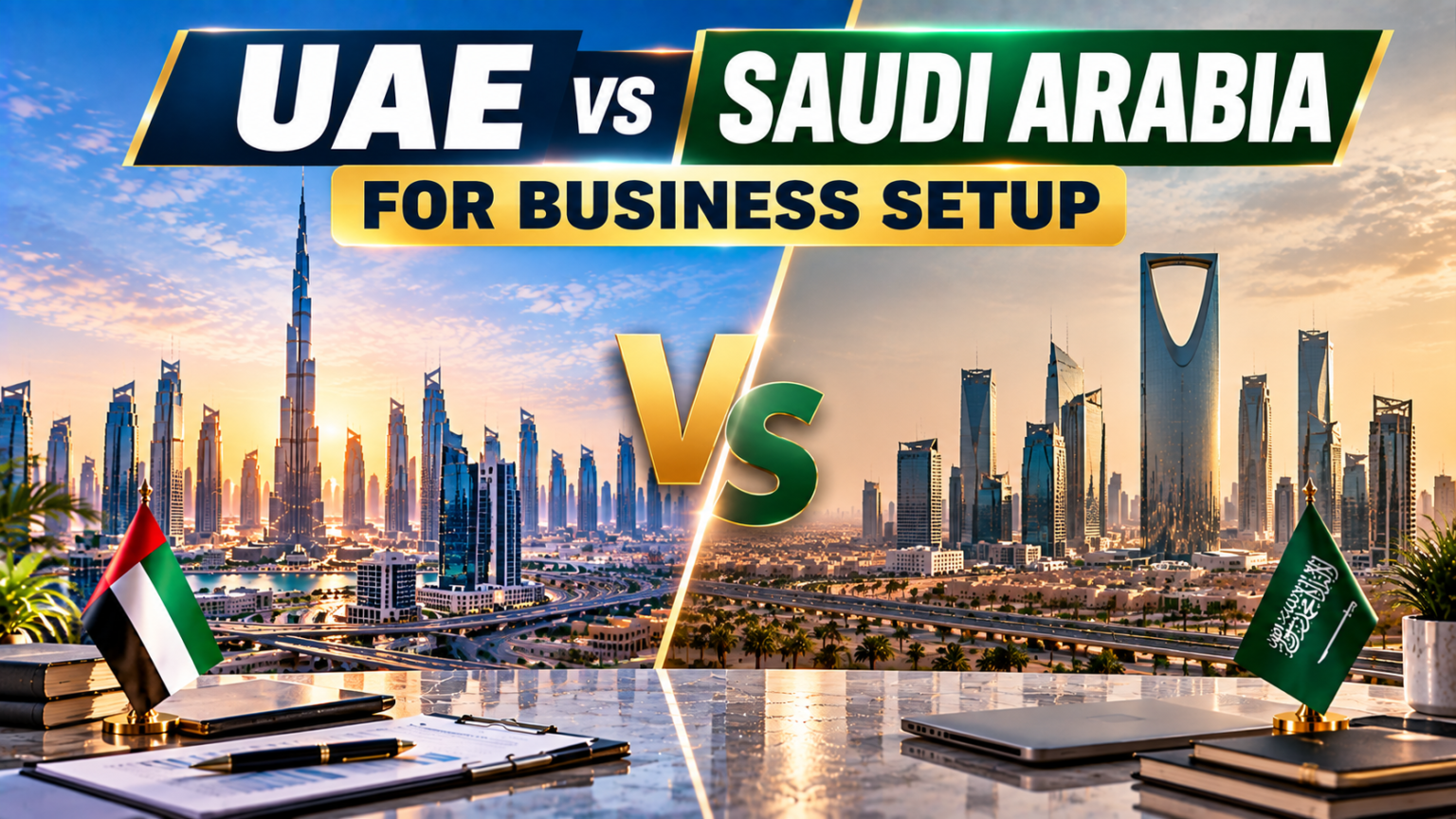
The Gulf business landscape is no longer a choice between one established hub and one emerging market. Both the UAE and Saudi Arabia are investing heavily in diversification, technology, infrastructure and international investment.
For an international founder, the practical question is: where should the company establish its first operating base, and does it need a second entity later? Some companies may benefit from a UAE regional HQ while establishing a Saudi subsidiary to serve the Kingdom directly. Others may find Saudi Arabia should be the primary market from the beginning.
Market Size and Customer Access
Saudi Arabia offers a very large domestic market and significant government and private-sector spending under Vision 2030. This can be especially attractive for construction, infrastructure, technology, tourism, entertainment, healthcare, professional services and industrial businesses.
The UAE has a smaller resident population but a highly international economy and a strong concentration of regional headquarters, investors, tourists and multinational companies. Dubai can be particularly effective when the business sells across multiple countries rather than relying only on the UAE domestic market.
| Factor | UAE | Saudi Arabia |
|---|---|---|
| Core advantage | International and regional operating hub | Large domestic market and Vision 2030 opportunities |
| Customer focus | Multi-country GCC, MENA and international customers | Strong fit for Saudi-focused customers and projects |
| Regional strategy | Useful for multi-country coordination | Useful when Saudi Arabia is the strategic centre |
| Business ecosystem | Broad Free Zone and mainland ecosystem | Mainland ecosystem plus economic zones and investment programmes |
UAE vs Saudi Arabia Tax Comparison
The UAE’s standard Corporate Tax framework generally applies 0% to taxable income up to AED 375,000 and 9% above that threshold, subject to the legislation. Qualifying Free Zone Persons may receive 0% on qualifying income if the relevant conditions are met. View the UAE FTA tax rates.
Saudi Arabia’s ZATCA states that the Income Tax Law applies to resident capital companies with respect to shares owned by non-Saudi partners and to non-residents conducting business through a permanent establishment or deriving income from Saudi sources. The general income tax rate relevant to non-Saudi ownership is commonly 20%, subject to applicable rules and sector-specific provisions. View ZATCA’s Income Tax guidance.
Regional Headquarters Strategy
Saudi Arabia has a formal Regional Headquarters (RHQ) Programme aimed at attracting multinational regional operations to the Kingdom. Invest Saudi describes the programme as a strategic hub for global enterprises and highlights tailored support and incentives. Explore Invest Saudi.
Dubai also has a strong regional-HQ ecosystem, with global businesses establishing and expanding regional offices. The choice depends on whether the company needs to be physically close to Saudi customers and government programmes or wants a more geographically connected base for several markets.
For a company whose commercial strategy is Saudi-first, a Saudi operating presence may be more important than choosing a UAE base purely for regional convenience.
Free Zones and Business Ecosystems
The UAE has a broad network of Free Zones covering technology, finance, commodities, logistics, healthcare, e-commerce and other sectors. The official UAE Government portal states that the country offers Free Zones for sectors including retail, agritech, health, FinTech, logistics, media and ICT. UAE Government business portal.
Saudi Arabia has its own economic zones and investment programmes, alongside mainland licensing through the relevant authorities. Businesses should compare the actual activity rather than assuming that one country’s “Free Zone” concept works exactly like the other’s.
Choose the Jurisdiction Around the Activity
A software company, trading company, logistics operator, financial services business and industrial company can have very different licensing requirements. The question should therefore be “Which jurisdiction fits my activity and customers?” rather than simply “Which country has cheaper company formation?”
Technology and Digital Businesses
For software, SaaS, AI and digital services, the UAE has a mature international technology ecosystem and strong connectivity. Dubai’s technology districts and AI initiatives can support companies targeting regional and global customers.
Saudi Arabia is also investing heavily in digital transformation and has a large domestic enterprise and government market. A technology business selling directly to Saudi institutions may find local presence commercially valuable even if its regional HQ is elsewhere.
For UAE-focused technology setup guidance, see How to Start an AI Company in the UAE and How to Start a SaaS Business in Dubai.
Logistics and Trade
The UAE is exceptionally strong for international trade, aviation, ports and re-export operations. Dubai’s airports, ports and logistics ecosystem make it a natural hub for companies moving goods across regions.
Saudi Arabia’s geographic scale and domestic market can make local distribution important when customers are spread across the Kingdom. A logistics business should model delivery distances, warehousing, customs and customer concentration before selecting its base.
Cost and Operating Complexity
Business setup cost is only one component. Compare office rent, employee salaries, visas, insurance, professional services, banking, tax compliance, technology, travel and customer-acquisition costs.
A UAE entity may be easier to use as a multi-country regional platform, while a Saudi operation may be more commercially efficient when most revenue is generated inside Saudi Arabia. The correct structure should minimise operational friction rather than maximise a headline tax advantage.
What Should Be Included in the Real Cost Comparison?
- Licence and incorporation costs
- Office and workspace
- Employee salaries and benefits
- Visas and immigration-related costs
- Insurance and professional services
- Accounting and tax compliance
- Banking and payment infrastructure
- Travel and logistics
- Customer acquisition and local representation
When the UAE May Be Better
The UAE may be the stronger first base for a company that needs international connectivity, regional clients, Free Zone ecosystems, global talent, financial services or a multi-country operating model. It can also be attractive to founders who want a relatively flexible base while testing GCC demand.
This does not mean the UAE is automatically better for a company whose primary customer is Saudi government or Saudi domestic enterprise. In that case, a local Saudi presence may be essential.
When Saudi Arabia May Be Better
Saudi Arabia may be the stronger primary market when the company’s strategy depends heavily on the Kingdom’s domestic demand, Vision 2030 projects, government procurement, local partnerships or a Saudi-focused workforce.
The RHQ programme can also be relevant to multinational groups whose regional management model is centred on Saudi Arabia. Companies should review programme eligibility and current requirements directly with Saudi authorities.
Can You Use Both?
For some groups, the most practical answer is both. A UAE regional hub can handle international finance, management, technology or multi-country operations, while a Saudi entity serves local customers and meets local operational requirements.
This structure introduces additional compliance, accounting and intercompany considerations. It should therefore be designed carefully rather than created simply because two countries are attractive.
UAE vs Saudi Arabia Decision Framework
Score each country from 1–5 for the factors below, then weight the categories that matter most to your business.
- Target-market revenue
- Regulatory and licensing fit
- Tax cost and compliance
- Talent availability
- Office and employment cost
- Logistics and travel
- Banking and payment flows
- Customer proximity
- Regional headquarters requirements
- Expansion potential
The result is more useful than a generic ranking. A Saudi-focused construction company and a global SaaS company should not reach the same conclusion simply because they are both “businesses in the GCC.”
UAE vs Saudi Arabia Setup Checklist
- Estimate revenue by country for the next three years.
- Identify your primary customer market.
- Check sector-specific licensing.
- Compare tax treatment and filing obligations.
- Compare employee and office costs.
- Assess logistics and travel needs.
- Review banking and payment flows.
- Consider regional HQ requirements.
- Decide whether one entity or two are needed.
- Model intercompany costs if using both markets.
- Prepare a realistic 12–24 month budget.
- Review the structure with local advisers before incorporation.
A Two-Stage GCC Expansion Model
A practical expansion strategy can be staged. A company may establish a UAE base, validate demand across GCC markets, then establish a Saudi entity when Saudi revenue and operational requirements justify it. Another company with a Saudi-heavy pipeline may reverse the sequence. The best model is the one that follows revenue and operational reality rather than forcing every business into the same structure.
AB Capital Support
AB Capital Services FZC can help international entrepreneurs compare UAE business structures, company formation, licensing, banking, visas, accounting and tax requirements. Where Saudi Arabia is also being considered, the decision should be based on the client’s market strategy and the current rules of both jurisdictions.
Speak With AB Capital
Looking at the UAE, Saudi Arabia or a two-market GCC expansion strategy? AB Capital can help you evaluate the UAE side of the structure, including company formation, licensing, banking, visas, accounting and tax compliance.
AB Capital Services FZC
Office No. 404, Al Tawhidi Building, Bank Street, Bur Dubai, UAE
Phone: +971 58 569 9300
Email: info@abcapital.ae
Also Read
- Dubai Business Growth 2026: Why More Companies Are Choosing the Emirate
- Dubai Economic Zones in 2026: What 96% Occupancy Means for New Businesses
- Mainland vs Free Zone Company Setup in Dubai 2026
- Company Formation in Dubai Mainland: 2026 Guide
- Dubai as a Regional Headquarters: Why Global Companies Are Choosing the UAE
- How to Start a Company in Dubai in 2026
FAQs: UAE vs Saudi Arabia for Business Setup
Is UAE or Saudi Arabia better for business in 2026?
It depends on the business. UAE is strong for international and regional operations; Saudi Arabia is particularly compelling for companies targeting the Kingdom’s large domestic market and Vision 2030 opportunities.
Which has the lower standard corporate tax rate?
The UAE standard Corporate Tax framework applies 0% to taxable income up to AED 375,000 and 9% above that threshold, subject to applicable rules. Saudi Arabia generally applies a 20% income tax rate to the relevant taxable base for resident capital companies and non-residents conducting business through a permanent establishment, subject to applicable rules.
Can I have a UAE company and a Saudi company?
Yes. A group can operate in both markets, but it must manage separate licensing, tax, accounting and intercompany requirements.
Should I put my regional headquarters in Dubai or Saudi Arabia?
Consider where your strategic management functions, customers and growth plans are concentrated. Both markets have regional-HQ opportunities. The correct choice should follow the operating model rather than a generic country ranking.
Is the UAE better for international business?
The UAE can be a strong choice for businesses that need international connectivity, regional clients, Free Zone ecosystems, global talent, financial services or a multi-country operating model.
Is Saudi Arabia better for businesses targeting Vision 2030 opportunities?
Saudi Arabia can be particularly attractive when the business depends on Kingdom-focused demand, major Vision 2030 projects, government procurement, local partnerships or a Saudi-focused workforce.
Is Dubai a good base if most of my customers are outside the UAE?
It can be. Dubai may suit businesses using the UAE as a multi-country regional platform, particularly where international connectivity, talent, financial services and regional operations are important.
Should a Saudi-focused company still consider a UAE company?
It may, but a UAE entity should have a clear commercial purpose. If most revenue, customers, staff and operations are in Saudi Arabia, the Saudi operating structure may deserve priority.
Who Provides Low Cost Business Setup in Dubai?
Looking for an affordable way to start a business in Dubai? AB Capital Services FZC provides low cost business setup options for entrepreneurs looking to establish a company in the UAE.
Depending on the selected jurisdiction, business activity and package, business setup options can start from just AED 3,555*.
Starting price for an available low-cost setup package
What Does the AED 3,555* Starting Price Depend On?
The final cost of setting up a business in Dubai depends on several factors, including the business activity, jurisdiction, visa requirements, office requirements and additional services selected.
- Business activity and licence type
- Free Zone or mainland jurisdiction
- Number of visas required
- Office or workspace requirements
- Additional approvals, if applicable
- Banking, accounting and tax services
A low-cost setup should not simply mean choosing the cheapest advertised price. The licence and structure should also match your actual business requirements.
Looking for Low Cost Business Setup in Dubai?
Speak with AB Capital Services FZC to understand the available setup options based on your business activity and budget.
AB Capital Services FZC
Office No. 404, Al Tawhidi Building, Bank Street, Bur Dubai, UAE
Phone: +971 58 569 9300
Email: info@abcapital.ae
*Starting price shown for the available low-cost package. Final pricing depends on the selected business activity, jurisdiction, visa requirements and applicable services.