


The UAE Global Star Rating System has become a defining factor in how government services operate across the country. In 2026, any entrepreneur, investor, or company interacting with UAE authorities will directly experience the impact of this system. Understanding the UAE Global Star Rating System is no longer optional, especially for businesses that rely on fast approvals, licensing, visas, and compliance processes.
This guide explains the UAE Global Star Rating System in detail, including how it works, how services are evaluated, what the ratings mean, and how it affects your business operations in the UAE.
What is the UAE Global Star Rating System
The UAE Global Star Rating System is a government-led framework designed to evaluate and improve the quality of public services across federal and local entities.
It was introduced to create:
- Consistency in service delivery
- Measurable performance standards
- Customer-centric government services
Unlike traditional government evaluation models, the UAE Global Star Rating System focuses heavily on customer experience, not just internal efficiency.
Why the UAE Global Star Rating System Was Introduced
Before the introduction of the UAE Global Star Rating System, service quality varied significantly between departments. The government aimed to:
- Eliminate inconsistencies
- Improve public satisfaction
- Enhance global competitiveness
- Create accountability across entities
Today, the UAE Global Star Rating System is one of the key reasons why the UAE consistently ranks among the top countries for ease of doing business.
How the UAE Global Star Rating System Works
The UAE Global Star Rating System evaluates government services across multiple channels:
- Physical service centers
- Websites
- Mobile applications
- Call centers
Each service channel is assessed using a combination of:
- Customer feedback
- On-site inspections
- Mystery shopper evaluations
- Performance metrics
UAE Global Star Rating System Score Breakdown
| Rating | Meaning | Business Impact |
| 2 Stars | Below standard | Slow processes, inefficiencies |
| 3 Stars | Basic service | Limited reliability |
| 4 Stars | Good | Acceptable performance |
| 5 Stars | Very Good | Smooth operations |
| 6 Stars | Excellent | Fast and efficient |
| 7 Stars | World-class | Premium service experience |
For businesses, interacting with a 6 or 7-star entity under the UAE Global Star Rating System can significantly reduce processing time and operational friction.
Key Evaluation Criteria in the UAE Global Star Rating System
The UAE Global Star Rating System is based on detailed evaluation criteria that go beyond surface-level performance.
1. Customer Experience
- Waiting time
- Ease of process
- Staff interaction
2. Service Efficiency
- Processing speed
- Accuracy
- Number of steps required
3. Digital Accessibility
- Online service availability
- Mobile responsiveness
- Integration between systems
4. Innovation
- Use of AI and automation
- Smart government initiatives
5. Environment and Facilities
- Service center design
- Accessibility for all users
Why the UAE Global Star Rating System Matters for Businesses
The UAE Global Star Rating System directly affects how businesses operate in the UAE.
1. Faster Business Setup
High-rated government entities process:
- Trade licenses
- Approvals
- Registrations
much faster.
👉 Related: https://abcapital.ae/business-setup-in-dubai
2. Reduced Delays and Errors
A higher rating under the UAE Global Star Rating System usually means:
- Fewer documentation issues
- Better guidance
- Less back-and-forth
3. Improved Compliance Experience
Businesses dealing with:
- VAT registration
- Corporate tax
- License renewals
benefit from streamlined processes.
👉 Related: https://abcapital.ae/corporate-tax-uae-guide
4. Better Digital Experience
The UAE has invested heavily in digital transformation.
Under the UAE Global Star Rating System, many services are now:
- Fully online
- Faster
- More transparent
5. Increased Investor Confidence
Global investors trust systems that are:
- Transparent
- Measurable
- Consistent
The UAE Global Star Rating System provides exactly that.
Channels Covered Under the UAE Global Star Rating System
| Channel Type | Description |
| Service Centers | Physical government offices |
| Websites | Official portals for services |
| Mobile Apps | Government apps for services |
| Call Centers | Customer support services |
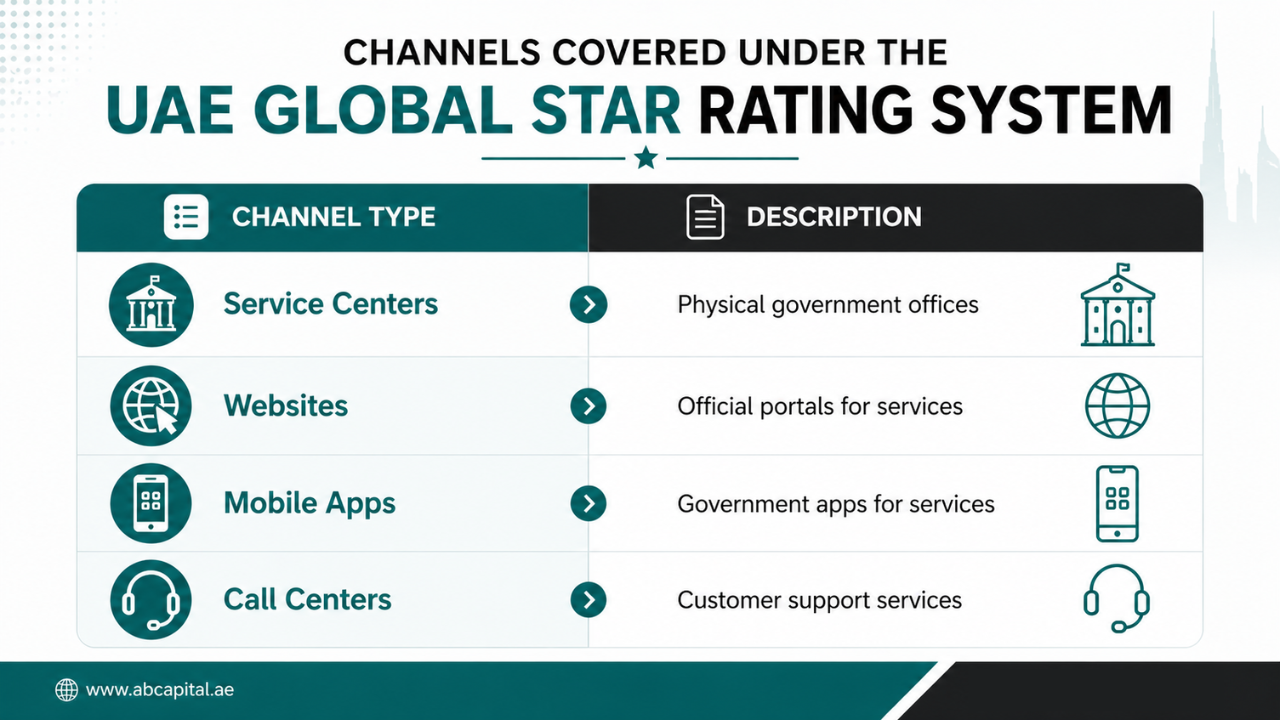
Each channel is independently rated under the UAE Global Star Rating System, ensuring consistency across all touchpoints.
Real Impact of the UAE Global Star Rating System
The UAE Global Star Rating System has transformed public services in measurable ways:
- Significant reduction in waiting times
- Higher customer satisfaction scores
- Increased adoption of digital services
For businesses, this means:
- Faster turnaround
- Predictable timelines
- Better planning capability
UAE Global Star Rating System and Digital Transformation
A major evolution of the UAE Global Star Rating System is its focus on digital services.
Government entities are now evaluated on:
- Online usability
- Automation levels
- Integration between departments
This shift has enabled:
- Paperless processes
- Instant approvals in some cases
- Reduced need for physical visits
Common Mistakes Businesses Make
Even with the UAE Global Star Rating System, businesses often face issues due to:
- Choosing the wrong service channel
- Not using digital platforms
- Incomplete documentation
- Lack of professional guidance
Avoiding these mistakes can significantly improve your experience.
How to Use the UAE Global Star Rating System to Your Advantage
1. Choose High-Rated Entities
Always prefer departments with higher ratings.
2. Use Digital Platforms First
Most high-rated services are optimized online.
3. Prepare Documentation Properly
This reduces rejection and delays.
4. Work with Experts
Professionals understand how to navigate the system efficiently.
Role of AB Capital Services
Navigating the UAE Global Star Rating System can still be complex, especially for new businesses. This is where AB Capital Services plays a key role.
AB Capital supports entrepreneurs and companies with:
- Business setup in mainland and free zones
- Corporate structuring
- Bank account assistance
- VAT and compliance services
- Government approvals and PRO services
Their experience with UAE regulatory systems ensures that clients interact with the right government entities, minimizing delays and maximizing efficiency. For businesses looking to establish or expand in the UAE, working with a knowledgeable advisory firm can make a significant difference.
Future of the UAE Global Star Rating System
The UAE Global Star Rating System continues to evolve with:
- AI-driven service evaluation
- Real-time customer feedback integration
- Expansion into new service channels
The goal is to make the UAE:
- Fully digital
- Highly efficient
- Globally competitive
Key Facts About the UAE Global Star Rating System
| Item | Detail |
| Launch Year | 2011 |
| Rating Scale | 2 to 7 stars |
| Coverage | Federal and local entities |
| Focus | Customer experience and efficiency |
| Channels | Physical and digital |
Key Takeaways
- The UAE Global Star Rating System ensures consistent, high-quality government services
- It directly impacts business setup, licensing, and compliance processes
- Higher-rated entities provide faster and more reliable services
- Digital transformation is a major component of the system
- Businesses can benefit by choosing the right channels and preparing properly
Conclusion
The UAE Global Star Rating System is more than just a performance framework. It is a core part of the UAE’s strategy to become one of the most business-friendly environments in the world.
For entrepreneurs and companies, understanding how the UAE Global Star Rating System works can save time, reduce costs, and improve overall efficiency. Whether you are starting a business, expanding operations, or managing compliance, this system plays a direct role in your experience.
As the UAE continues to innovate and improve its services, the UAE Global Star Rating System will remain a key driver of quality, transparency, and global competitiveness.