

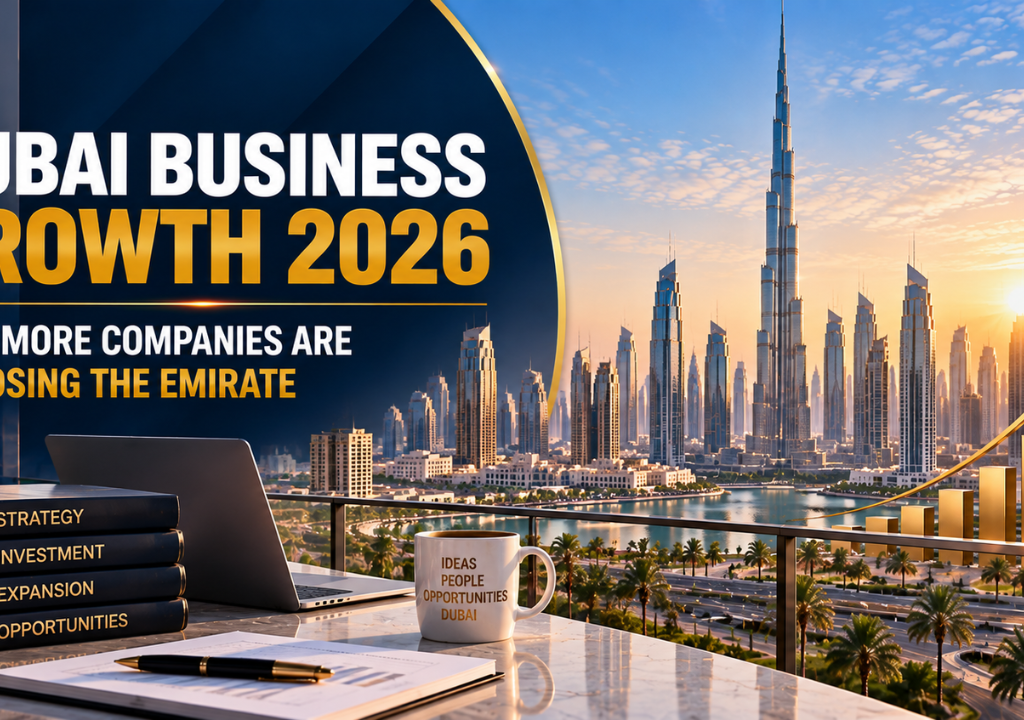
Dubai Business Growth 2026: Why More Companies are Choosing the Emirate
Table of Contents Quick Answer Dubai's Growth Story Is Broader Than Company Registrations Economic Growth in 2026 Trade and International Connectivity Technology Is Becoming a Core Growth Engine Real Estate and Construction Create Secondary Demand Free Zones and Mainland Structures What Founders Should Evaluate Before Setting Up Why Established Companies Are Looking at Dubai Risks and Realistic Expectations AB Capital's Role FAQs Also Read Quick Answer Dubai’s business growth in 2026 is being supported by a combination of economic expansion, international trade, technology investment, real estate activity, infrastructure and a strong ecosystem of Free Zones and mainland businesses. Dubai’s GDP reached AED 232 billion in Q1 2026, growing 2.4% year on year, while economic zones and business communities continued reporting growth in companies and workforce. For entrepreneurs, the opportunity is not simply lower tax; it is access to customers, capital, infrastructure, logistics and a regional market. Summarize with ChatGPT Dubai’s Growth Story Is Broader Than Company Registrations A company formation decision is often made by looking at licence costs or tax rates alone. In practice, a location becomes valuable when it helps a company find customers, hire people, access suppliers, raise capital and move goods or services efficiently. Dubai’s 2026 growth story is therefore important because several parts of the economy are moving together. Technology, trade, tourism, real estate, professional services and logistics continue to create demand for new businesses. That creates opportunities for both startups and established international companies entering the region. Economic Growth in 2026 Dubai’s Q1 2026 GDP reached AED 232 billion and recorded 2.4% year-on-year growth. That headline number matters because it provides a broader context for business confidence. A growing economy can support demand across multiple sectors, although individual companies still need to validate their own market and business model. The opportunity is especially relevant for service businesses that can operate regionally from Dubai. A UAE entity can be structured around the company’s actual commercial requirements rather than simply being a registration address. Trade and International Connectivity Dubai’s position between Europe, Asia, Africa and the Middle East remains one of its strongest commercial advantages. The city combines international airports, ports, logistics networks, financial services and a large professional-services ecosystem. The UAE–India trade relationship is one example. Dubai’s non-oil trade with India reached AED 222.5 billion in 2025, while the number of active Indian Dubai Chamber members reached 85,841 by June 2026. This illustrates how Dubai can function as a commercial bridge rather than merely a local market. Technology Is Becoming a Core Growth Engine Technology is no longer a niche sector in Dubai. AI, cloud computing, cybersecurity, software, automation, data analytics and digital commerce are increasingly embedded in business strategy. Dubai’s AI initiatives also aim to accelerate commercial adoption and build supporting infrastructure. For founders, this creates two opportunities. Technology companies can establish operations in Dubai, while traditional businesses can use the ecosystem to modernise their operations. The strongest business cases often combine technology with an existing commercial need. Real Estate and Construction Create Secondary Demand Dubai’s real estate market also influences business formation. In H1 2026, 104 real estate projects were completed with a combined value exceeding AED 111 billion. New development creates demand for brokers, property managers, design firms, contractors, technology providers, legal and accounting professionals, marketing agencies and specialist suppliers. This does not mean every property-related business will succeed. It means the scale of development creates a wider ecosystem in which specialist service companies can operate. Free Zones and Mainland Structures Dubai offers different establishment routes because businesses have different requirements. Mainland companies can serve the wider UAE market subject to the applicable licensing and activity rules. Free Zones can provide sector-focused ecosystems, infrastructure and ownership structures. The right choice depends on the activity, customers, visa needs, office requirements, banking plans and future expansion. Choosing a Free Zone simply because it is advertised as inexpensive can become costly if the structure does not match the business model. What Founders Should Evaluate Before Setting Up A serious Dubai market-entry plan should answer: Who is the customer? Where will the customer be located? Will the company invoice UAE clients, overseas clients or both? Does the activity need special approval? Will employees be hired? Is a physical office required? Which bank relationship is appropriate? What Corporate Tax and VAT obligations may arise? How will accounting and compliance be managed? These questions produce a more useful setup decision than starting with a generic ‘cheapest licence’ search. Why Established Companies Are Looking at Dubai For international companies, Dubai can be a regional operating base. A company may use the emirate for sales, management, distribution, regional headquarters or specialist services. The value comes from combining a UAE presence with the company’s existing international network. The growth of economic zones, business communities and multinational activity suggests that Dubai is competing not only for startups but for regional operations and investment. Risks and Realistic Expectations Dubai is not a guaranteed-success market. Competition can be intense, office and staffing costs vary, and some sectors require approvals. A founder should also budget for accounting, tax, visas, insurance, banking and renewal costs rather than focusing only on the initial licence. A strong market-entry plan should therefore include a 12-month cash-flow forecast and a clear customer-acquisition strategy. AB Capital’s Role AB Capital Dubai can help entrepreneurs evaluate company structure, licensing, banking, visas, accounting and tax requirements before establishing a business in Dubai. The goal should be to create a compliant structure that supports the commercial plan rather than choosing a structure first and adapting the business later. FAQs Is Dubai still a good place to start a business in 2026? Dubai remains a major international business hub, with economic and business-community growth in 2026, but success depends on the sector, business model and execution. Should I choose mainland or Free Zone? It depends on your activity, customers, office and operational requirements. Is Dubai only attractive because of tax? No. Connectivity, infrastructure, trade, talent, capital and market access are major factors. Can an overseas
Dubai Business Growth 2026: Why More Companies are Choosing the Emirate Read More »