

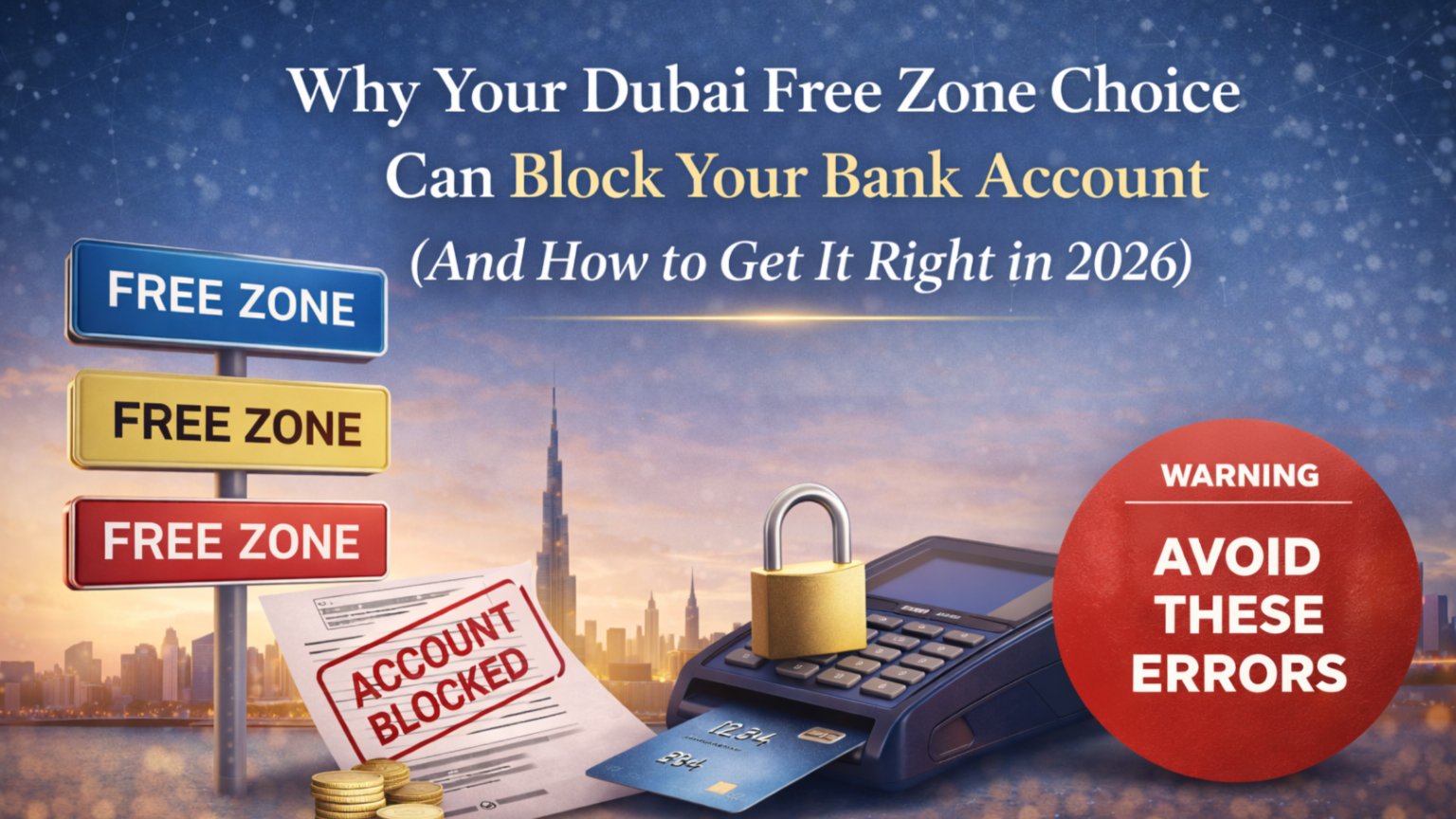
| Quick Answer- Not all UAE Free Zones are viewed equally by banks. Your Free Zone choice affects your banking credibility, corporate tax exposure, and compliance risk. Selecting the wrong jurisdiction can result in bank rejections, documentation delays, and costly restructuring. This guide explains how to align your Free Zone with your business profile before you incorporate. |
The Free Zone Promise vs. Banking Reality
Dubai has built a global reputation as a business-friendly destination, and for good reason. Its Free Zones offer a compelling combination of 100% foreign ownership, import and export tax exemptions, and a headline corporate tax rate that can be 0% under the right conditions. These advantages attract thousands of entrepreneurs and investors each year.
But there is a critical gap between what Free Zones promise at the licensing stage and what banks require before they grant your company an account. This gap catches many founders off-guard, sometimes months after they have already paid for their license.
The core issue is this: banks and licensing authorities evaluate your business through entirely different lenses. A Free Zone authority cares whether your activity fits its permitted list and whether your paperwork is in order. A bank goes much deeper. It is assessing risk, evaluating the credibility of your business model, and deciding whether your company poses an acceptable compliance exposure.
That disconnect is where banking problems are born.
What Banks Actually Evaluate Before Saying Yes
Before approving a corporate account, UAE banks run a thorough due diligence review. Understanding what they look at is the first step toward structuring your company to pass that review.
Banks typically assess the following factors:
- Business activity and commercial logic: Does your company’s licensed activity match what you actually plan to do? Does the business model make practical sense?
- Source of funds: Where did your initial capital come from, and can you document it clearly?
- Shareholder background: Who owns the company, where are they from, and do they have any adverse records?
- Expected transaction flow: What currencies will you transact in, which countries will your clients be based in, and what volume do you anticipate?
- Geographic exposure: Does your business involve countries or regions that carry elevated compliance risk?
Your Free Zone registration only becomes a significant factor when it does not align with the answers to the above questions. A mismatch between your jurisdiction and your business profile is a red flag. Banks interpret it as a sign that your structure was chosen for administrative convenience rather than genuine operational reasons, which increases their perceived risk.
Why Free Zone Selection Affects Banking Outcomes
UAE has over 40 Free Zones, each with its own regulatory authority, permitted activities, and market positioning. From a banking perspective, these jurisdictions are not interchangeable. Each carries a different risk profile depending on the types of businesses it hosts, its level of regulatory oversight, and its international reputation.
For instance, a Free Zone known for hosting financial services or consultancy firms will be evaluated differently than one that primarily houses trading or manufacturing operations. A consultant applying for a bank account from a zone that mostly houses import-export businesses may face additional scrutiny, because the jurisdiction is not associated with the activity being declared.
Similarly, not all Free Zones are perceived equally in terms of governance quality and regulatory rigour. Banks factor this into their assessment, even if no explicit blacklist exists.
This means choosing a Free Zone purely based on license cost or processing speed, without considering your banking needs, can create structural problems that are difficult and expensive to undo later.
The Three Triggers That Lead to Bank Rejection
Based on common patterns in UAE banking rejections, most problems trace back to one of three root causes:
1. The Free Zone Does Not Match the Business Activity
Banks expect to see a natural alignment between the jurisdiction you selected and the type of business you are operating. If you registered as a media consultant in a Free Zone primarily associated with logistics, or as a fintech company in a zone known for retail trading, compliance officers will question the logic behind that choice.
The practical result is extended document requests, additional rounds of questioning, or outright rejection.
2. The Structure Appears Set Up for Convenience Rather Than Operations
UAE banks are alert to companies that appear to exist only on paper. If your registered address is a flexi-desk with no staff, your declared revenue is significantly higher than what the business stage justifies, or your shareholder is based in a high-risk country with no prior UAE business history, the bank will classify your application as elevated risk.
This does not necessarily mean rejection, but it does mean a longer and harder process, often requiring additional documentation, in-person meetings, and letters of explanation.
3. Transaction Expectations and Geographic Exposure Do Not Add Up
If you tell a bank you expect to process AED 2 million per month in a year from a brand-new startup, with clients spread across multiple high-risk jurisdictions, you are creating red flags even before a single dirham changes hands. Banks need transaction projections to be credible and consistent with your business stage and structure.
A well-planned banking narrative, aligned with your Free Zone choice and company structure, prevents this problem before it starts.
The Real Cost of Getting This Wrong
Many founders only discover these issues after incorporation, which is when the costs become serious. The consequences of a misaligned Free Zone choice include:
- Delays of weeks or months in receiving bank approval
- Repeated requests for documentation that was not required initially
- Multiple rejections across different banks, which can damage your company’s compliance record
- The need to restructure the company entirely, including changing Free Zones, revising the license activity, or amending the shareholding structure
- Additional legal and administrative fees to remedy what was a preventable structural error
Beyond cost, there is an opportunity cost. Every week without a functioning bank account is a week your business cannot invoice clients, receive payments, or operate commercially. For entrepreneurs relocating to Dubai or launching a time-sensitive venture, this delay can derail the entire business plan.
How to Structure Your Business for Banking Success
The solution is not complicated, but it does require thinking about banking before you choose your jurisdiction. Here is the framework AB Capital uses when advising clients on Free Zone selection:
Map Your Business Activity to the Right Zone
Start with your actual business model, not the cheapest license available. Different Free Zones are optimised for different sectors. Technology businesses, creative agencies, consultants, financial services providers, and trading companies each have jurisdictions that are better aligned with their activity from both a regulatory and banking perspective.
Consider Where Your Clients and Transactions Will Be
If the majority of your clients are based in the UAE, a Mainland license is often more appropriate and more credible to banks. If you are running an international services business with clients across Europe, Asia, or North America, a Free Zone structure can work well, provided you select a zone with strong international credibility and clear activity alignment.
Build a Banking Narrative Before You Apply
Banks want to understand your business, not just see your license. Before you walk into any bank, you should be prepared to clearly explain what your company does, who your clients are, what your transaction volumes will look like, and why you chose the structure you did. Having a well-prepared bank introduction package significantly improves your approval odds.
Understand the Corporate Tax Implications
The UAE introduced a 9% Corporate Tax in 2023. Whether your Free Zone company qualifies for the 0% rate depends on whether you meet the Qualifying Free Zone Person criteria, which includes earning Qualifying Income and maintaining adequate Economic Substance in the UAE. Choosing the wrong Free Zone, or failing to meet substance requirements, can result in exposure to the 9% rate even when you expected to pay nothing.
What AB Capital Does Differently
At AB Capital Services, we do not simply process license applications. Our approach starts with understanding your business model, revenue sources, shareholder background, and banking requirements before recommending a jurisdiction.
We match clients to Free Zones based on banking compatibility, corporate tax positioning, and operational needs, not just license cost. Our team has direct experience navigating the UAE banking landscape, and we have built relationships with account managers at major UAE banks that allow us to prepare clients correctly before submission.
Our 3-working-day bank account opening timeline is not a marketing promise. It is the result of doing the structure work correctly upfront so that the application process moves without friction.
Final Word: Structure First, License Second
Dubai remains one of the most attractive business destinations in the world. The 0% corporate tax advantage is real, the banking infrastructure is sophisticated, and the legal framework is business-friendly. But these advantages are not automatic. They are available to businesses that are structured correctly.
The decision you make on which Free Zone to register in will shape your corporate tax exposure, determine how smoothly your banking application proceeds, and establish the foundation your entire UAE business operates on. It is not a decision to make based on cost alone.
If you are planning to set up a business in Dubai in 2026 and want to get the structure right from day one, speak with our team at AB Capital Services. We offer a complimentary initial consultation to assess your business model and recommend the structure that gives you the best combination of tax efficiency, banking compatibility, and compliance confidence.
Contact AB Capital Services
- Phone / WhatsApp: +971 58 561 9500
- Email: info@abcapital.ae
- Website: abcapital.ae
- Office: Suite 404, Al Tawhidi Building, Bank Street, Bur Dubai
AB Capital Services FZE | SRTIP License No. 1543 | FTA Registered TRN 104126416700003 | Led by Mr. Bharat Bajaj, FTA Approved Tax Agent